By Joe Diorio
The Tennessee state legislature met recently to discuss measures related to gun safety. Tennessee was ground zero for a horrific mass shooting at a private school earlier this year, and emotions in the statehouse were a bit raw.
Very little was accomplished during the ten-day session, but a local reporter Tweeted (X’ed? I can never tell), paraphrasing Tennessee Lieutenant Governor Randy McNally indicating that more would be done on gun safety in January during the legislature’s regular session, “when they have more time to flush out [the] issues.”
Welp, to “flush out” means to remove something, whereas to “flesh out” means to build up or add to. I am not sure which meaning the reporter or Lt. Governor McNally wanted to use but considering that most Republican lawmakers (and Tennessee’s state house is overwhelmingly Republican) react to laws about guns the same way Superman reacts to kryptonite, then they may have meant “flush out.”
Stormfront writing
Colleague and friend Jeff Butera, author of Write Like You Talk. A Guide to Broadcast News Writing, offered a few helpful tips for anyone writing about hurricanes. And considering we’re in the midst of hurricane season, I suspect more than a few of us are writing about hurricanes.
Among his advice is to avoid subjective, dramatic, or sensational adjectives. Eleven years after Tropical Storm Sandy hit the U.S. East Coast it is still referred to as “Superstorm Sandy.” So unnecessary adjectives can take on a life of their own.
A new word is slowly entering the lexicon
As I have said before, words become words when they are used often enough to be considered part of our language. Some terms, like, “covfefe,” which came up in the early days of the Trump administration, come and go. Others have more staying power.
We may be witnessing a word – “Barbenheimer” – that may well enter the dictionary. Barbenheimer is a portmanteau for “Barbie” and “Oppenheimer,” and it is becoming shorthand for polar opposites. It sprouted from the popularity of the two movies, which themselves are polar opposites. Just recently, the public release of the mugshot of former President Trump and the availability of pumpkin spice lattes on the same day was described as a “Barbenheimer” moment.
Now lexicographers take their time before opening the pages of the dictionary to new words, but this one has a shot at Merriam Webster immortality. And you can say you knew it when.
Speaking of new words, Dictionary.com just announced that several words were officially words, including “Jawn,” which is a Delaware Valley term used when the speaker does not know or need an official term. Now you know.
Young journalists and faith in the Fourth Estate
Three years ago, the editors of the Daily Tar Heel at the University of North Carolina described the stop-and-go attempts at reopening the UNC campus during the COVID-19 pandemic as a “clusterfuck.” The profound use of profanity – in a headline, no less – may not have been appreciated by everyone, but it got the point across.
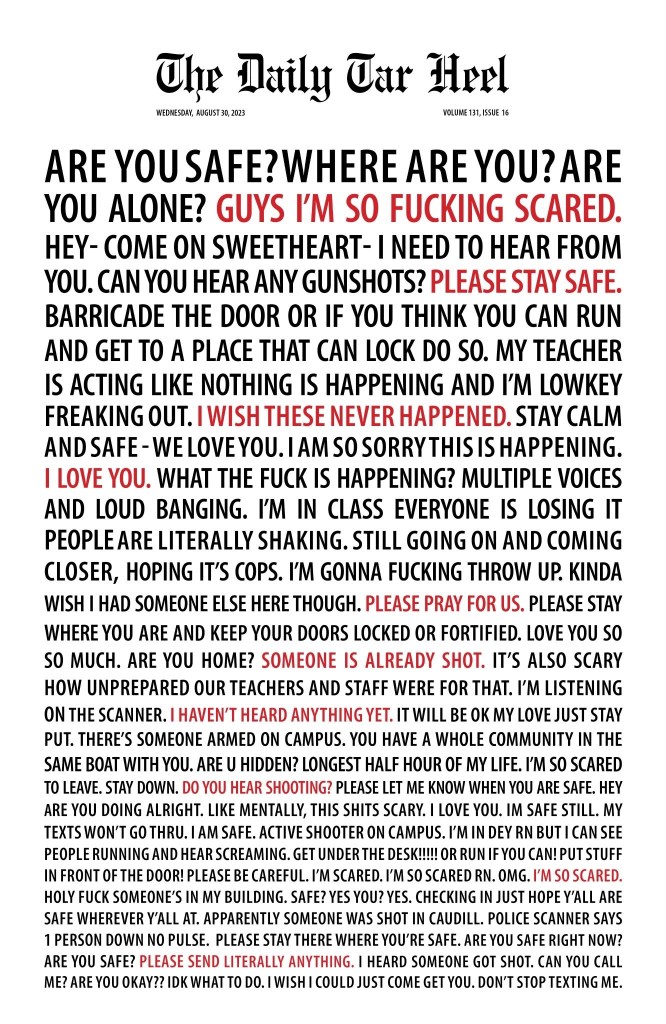
Late last month when a shooting at the UNC campus resulted in the death of a faculty member and sent scores of students into hiding, the Daily Tar Heel used the visual impact of multiple text messages to deliver the message that things are not normal in a world where shootings occur on a regular basis.
It demonstrates the power of words and restores my hope for journalism’s bright future.
Let’s write carefully out there, people.
Joe Diorio’s first book, A Few Words About Words, is available now. His next book, Murders at Trask: Crisis communications and the art of making nothing happen is forthcoming.

 Joe Diorio Writer, editor.