Knowing when to be still

By Joe Diorio

May 7, 2025

I share a media dilemma with Jordon Hudson, the girlfriend of former New England Patriots head coach Bill Belichick. During a recent interview with CBS News, Hudson, who is 50-plus years younger than Belichick, shot down a question from reporter Tony Dokoupil about how she and the eight-time Super Bowl winning coach met.

Forty-three years ago, I tried shooting down questions from a newspaper reporter and damn near got myself fired.

It was 1982 and my employer, the IBM Corporation, was going to hold its annual shareholders meeting in Jacksonville, Florida. When IBM’s public relations staff told the Jacksonville news media about this the reaction from news reporters was, “Why Jacksonville?”

 IBM tried its darndest not to answer that question. It didn’t work out well.

In the weeks leading up to the April 1982 meeting the local newspaper asked if they could interview a “typical” IBMer. The manager of the local IBM sales office was identified as “typical.” IBM also decided to have a public relations professional sit in on the interview.

 I drew the short straw and was that P.R. professional.

 I was instructed to make sure no questions were asked that would seem “un IBM-like.” No one told me what an “un-IBM” question was, so when the reporter asked the branch manager if he experienced a sense of glee when his sales team won a bid for new business, and when the manager started to flounder in his response, I chimed in and said it was all about fair competition and not beating the other guys. Basically, I told the reporter we were not answering that question.

 The reporter’s story, therefore, noted that “IBM flew a P.R. professional, Joe Diorio, into town to shoot down any questions the company didn’t like.”

 An executive at IBM’s Armonk, New York headquarters read that and bellowed, “What’s a Joe Diorio???”

From that moment on until I left IBM (on my own; I wasn’t fired), my nickname in some circles was “WhatsaJoe.” It still isn’t funny.

I’m not Jordon Hudson, but the blowback over my actions were as bad as it was when Hudson, upon hearing Dokoupil ask Belichick how he met her, interrupted the interview, saying “We’re not talking about this.” Belichick never answered and just glared at Dokoupil as though he was a game official who just made a questionable call against his team.

It’s been over a week since that interview and the angry exchange has not vanished from the news.

Similarly, 43 years ago the press never stopped asking IBM why it selected Jacksonville for the annual meeting. A colleague said to me, “it’s almost as though they were saying, “Why this hellhole? Or are they looking for some evil intention?”

The reality behind IBM’s selection of Jackson was not evil and it was not an attempt to have the meeting in some backwater town. North Florida in 1982 had a very large concentration of retired IBM employees living there, almost all of whom were shareholders. It made perfect sense, therefore, to have the shareholder meeting near shareholders.

Why IBM didn’t want to just say that still makes no sense to me. I am convinced that if someone said that to the Jacksonville press the “why Jacksonville” question would have gone away, I wouldn’t have had to sit in on an interview, and my uncomfortable nickname would never been created.

I cannot speak for Hudson or Belichick, but it seems like a simple, “we met online” or something equally innocuous would have answered the question Dokoupil was asking and, according to the subtitle of my book on crisis communications, “made nothing happen.”

But like I said, I’m not Jordon Hudson. But I did learn my lesson that open communication is better than obstruction.

Joe Diorio is the author of “Crisis Communications and the art of making nothing happen” (Beaufort Books, 2025) and “A Few Words About Words. A common-sense look at writing and grammar (Beaufort Books, 2021).

A Necessary Redo

By Joe Diorio

I’m writing a new edition of A Few Words About Words. Here’s why.

Joe Marshall was a lifelong corporate communications professional who loved the written word. He first worked as a newspaper reporter in Poughkeepsie, New York; then later with the International News Service, Newsweek magazine, and the legendary New York Herald Tribune daily newspaper. In those jobs, and later as a communications manager with IBM, he was renowned for producing the clearest and easiest to read prose. His fixation on letter perfect copy also drove more than a few people who worked with or for him crazy.

Imagine being a low- to mid-level corporate communications professional tasked with writing and producing a brochure or newsletter on some new tech IBM was about to introduce to the market. This always was a huge undertaking at IBM. Creating the newsletter or brochure or even the basic press release announcing the new widget was an experience tantamount to jumping through hoops of fire and landing barefoot on shards of glass. Honest, you were trying to get product managers to talk to you in non-jargon terms, then tell you why their latest and greatest product mattered and differed from its predecessor and similar products from the competition, explaining everything in layman terms (it would have been easier to ask them to stop breathing), then write something in Associated Press style (not heavily laden with jargon and at a ninth grade reading level) and get it ready for design.

After doing all that you had to repeat the whole process – only this time you also feel like you are a clay pigeon at a skeet shooting center – in order to get what you wrote approved, develop a design for the brochure everyone agrees on (this often involved keeping graphic designers awake all night to make last-minute changes), and doing it all within a prescribed budget and deadline.

When you finished going through this communications torture chamber, when you are just about to let the printer start the presses, Joe Marshall would say in his high-pitched raspy voice, “Can I have a look at what ya got?”

Those nine words would make you tense up and grit your teeth. But because he was your boss, you’d hand Joe the work you have literally been bleeding at the fingertips to produce and waited. Five minutes later (Or less, he was a quick read.) Joe would come back to you and say, “Ya know what this needs?” Typically, that “need” required a wholesale rewrite of everything. It meant you were once again going through the torture chamber of approvals.

You would gnash your teeth. You would resist the urge to strangle him. (Which at times was tempting; Joe wasn’t a physically big or imposing man.) But then you would stop yourself, look at his notes and think about what he was asking you to do, and you would realize: He’s right. If I don’t do what he’s asking, then I’m settling.

Joe didn’t want you to settle. In his mind, “good enough” never was good enough. And, when all was said and done, you didn’t want “good enough,” either.

It’s been nearly 40 years since I worked with Joe. I realize his changes – often the wholesale rewrites he made you do – always made my work better. I wasn’t settling for good enough.

I thought of Joe when I set about creating this new edition of A Few Words About Words. Yes, the first edition was good. But as I said more than once in that book, language is a forever evolving thing. We didn’t have artificial intelligence producing copy for us when AFWAW was published, we found emojis were increasingly becoming a permanent part of our communications toolbox, phrases and terms that were so much a part of the COVID-19 pandemic did not stick around (some did; for example, we now Zoom all the time), and there were questions about punctuation and word usage that more than a few readers of A Few Words About Words say they were looking for.

 We work with the written word even more today than we did just three years ago. So, a second edition – not one that just has some additional material tossed in – made sense.

In doing another edition I committed myself to Joe’s prodding and refused to settle. Getting it right is worth the effort. And today I’m the only one making myself jump through hoops and walk barefoot on shards of glass. It still hurts, but it is worth the effort.

Joe passed away in 2018 at the age of 91. Somewhere, he’s looking down at me – probably in between suggesting to Saint Peter that parts of the Bible could use some editorial “massaging” – and he’s smiling.

Thanks, Joe, for making sure I never settle for good enough.

Joe Diorio is the author of A Few Words About Words: A common-sense look at writing and grammar (Beaufort Books, 2021) and the forthcoming Crisis Communications and the Art of Making Nothing Happen (Beaufort Books, January 2025).

Second Book Available for Preorder Now

By Joe Diorio

My second book, Crisis Communications and the Art of Making Nothing Happen, takes a look at another communications skill: Crisis planning. Here is an excerpt from the introduction:

I was shot at by a crazed gunman during a mass shooting. He missed. I’m naturally as ugly as I appear. (Yes, I joke about it. The memory can be horrific if I dwell on it too much.) But he did not miss three of my coworkers. This happened on May 28, 1982, the Friday before Memorial Day.

Over 40 years later, I still have two distinct memories of that day. The first was the understandable fear of possibly dying by gunshot. I was convinced I had arrived at the moment where I would die as I lay on the floor under the conference table in the room where my coworkers and I hid, repeating the Lord’s Prayer over and over. For me, the end wasn’t near. It was here. The second, less obvious emotion was frustration and anger with my employer, the IBM Corporation.

I wasn’t angry because the shooting happened. I was angry because I was severely criticized for doing what I thought was my job.

The shooting happened when a former IBM employee drove his Lincoln Town Car through the glass doors of an IBM building in Bethesda, Maryland, emerged holding two weapons and started shooting at anything and anyone.

He fired in my direction as I stood outside of a coworker’s office. Seconds before I heard Audrey, my admin, screaming, “There’s a guy with a gun, and he’s shooting the place up!” I saw Audrey running toward me and about 20 feet behind her was a man in a ski mask wearing what appeared to be a U.S. Army surplus jacket. His choice of a coat was strange to me since it was hot and humid outside. (Yes, I was dwelling on trivial facts at that moment.) He fired the gun—I think it was a shotgun—and the bullets hit the wall where I would have been standing had I not ducked. I saw the damage to the wall the next day when I returned to the building to retrieve my suit jacket, car keys, and wallet.

Three people were shot and killed in this incident and the hundreds of IBM employees who worked in that building were trapped for hours until a police S.W.A.T. rescued them and finally arrested the shooter … who had barricaded himself in an office.

The following Tuesday I returned to work. My coworkers and I ran a regional public relations office in Bethesda. Our primary job was product publicity but on this day, we were responding to dozens of inquiries from the press. “Can we film in the building?” “Can we talk to employees?” “Can you tell us about the victims?”

We answered the questions as best as we could. No, you cannot come into the building. You can talk to employees if you locate them on your own but, again, you cannot come into the building. And no, we will not release information about the victims. Maybe those weren’t the best responses, but we were flying by the seats of our pants.

That is until someone at IBM’s corporate headquarters in Armonk, New York got wind of what was happening in Bethesda. Rather than a “how can we help?” phone call we received a “What the hell are you DOING?” message.

From the perspective of myself and my coworkers, IBM did not have a plan for handling the onslaught of press calls. They did not, in other words, have a crisis communications plan. Or as I say, if there was one it was not shared with us.

And that was not necessarily anyone’s fault. IBM in 1982 excelled at product publicity; find stories that show how IBM products are used. Just a few weeks before the shooting I placed a story in the fledgling newspaper USA Today about a gym in downtown Washington, D.C. that was using an IBM Personal Computer to run body fat analyses on clients. That application is commonplace today, but it was a cutting-edge use of technology back in 1982.

But managing communications after a crisis was a horse of a different color for Big Blue.

After quickly calling my coworkers, supervisor, and myself on the carpet for answering press questions, IBM cobbled together a response plan that would have a communications professional who worked for another IBM division in Washington handle all press calls.

I wasn’t shot that day, so I wasn’t considered a victim. And I don’t consider myself a victim, either. But I nevertheless became a part of a mass shooting. It’s a club no one wants to join, but it is a club that sadly has a growing membership. The Gun Violence Archive estimates that, this year, as of July 4, 2024, there were 261 mass shootings in the United States. It is an out-of-control problem.

My anger at the time was real, but I hold no grudge against IBM. The anger was more from a feeling of, “Hey, I just got shot at, and you’re yelling at me?”  Well, my emotional wounds from IBM’s corporate office’s verbal reaming healed quickly enough. Today I laugh at the memory (of being yelled at, not shot at) more than anything else.

As I said, IBM did not have a crisis communications plan for the events of May 28, 1982. Or if one existed, it was not shared with the regional press office in Bethesda.

There was no mention of the shooting in the company annual report for 1982. The CEO of IBM at the time, John Opel, visited the site over the weekend as repairs were taking place, and preparations were made to accommodate his visit. There was no press involved with his visit. In a sense, the event was pushed under the proverbial rug.

Yet IBM did a lot of positive things after the shooting. IBM streamlined the process of paying medical bills, significantly reducing the paperwork someone would have to complete. IBM also hired psychiatrists to be on-site in the building to talk to anyone who was experiencing any degree of post-traumatic stress. The company arranged for someone from the Montgomery County, Maryland district attorney’s office to conduct weekly updates regarding the status of the trial against the shooter.

IBM spent a fortune fixing the building quickly so that it bore no sign of damage when everyone returned to work four days after things hit the fan. By Tuesday morning, June 1, as people returned to work there was no sign that a shooting and a loss of life had happened. Damaged plaster walls were repaired or replaced, and a fresh coat of paint was applied to the entire building, not just the areas damaged by gunshots. Broken glass was replaced. The lobby was completely repaired, including replacing the carpeting where the Lincoln Town Car had sat after crashing through the glass doors.

The only faint sign of trauma in the building when everyone returned to work on Tuesday were the glass double doors that were destroyed when the car crashed through them. They were custom-made ten-foot-high glass doors. There was a double set of these doors at the north and south entrances to the building (the shooter drove through the south entrance); the space in-between the doors acted as a kind of vestibule to keep wind, leaves, and other things from blowing into the lobby. Since the replacement doors were a special order (“You could just about name your price for those,” one person close to the reconstruction of the building told me. And in reality, someone probably did.), the new doors were not ready for Tuesday’s return to work. Instead, one set of the ten-foot-high glass doors from the north side of the building were used to temporarily replace the shattered entrance at the south side.

Concrete bollards were installed at the base of the sidewalk outside of the building, a move to prevent another car from jumping onto the sidewalk and entering the lobby. Eventually bollards became “de rigueur” design elements on most buildings throughout the country.

All these things would be considered feathers in any company’s hat today. Yet IBM did not speak a word of it to anyone on the outside.

In the four decades since May 28, 1982 we have seen how mass shooting events are communicated by the businesses, the people involved, and interested parties. There were live tweets from the Las Vegas mass shooting in 2019, police departments use “X” messages for use in a variety of crisis and near crisis situations. Schools have partial and total lockdown procedures and active shooter drills.

It’s easy to see crisis plans in action today. Fast forward nearly 40 years to September 23, 2021 and a shooting at a Kroger grocery store in Collierville, Tennessee. When the store reopened several weeks later, after the damage to the store was repaired and law enforcement officials had completed their investigations, there were marching bands, speeches from politicians, and a more positive vibe that was communicated through events, live TV news conferences. The message being sent that day was: “We’re back, we’re stronger than ever, and this incident does not define us.”

The planning and implementation Kroger and other places where mass shootings have taken place come from conscious efforts to put a face on a tragedy. In each case there was a plan to identify the situation, activate a team, maintain clear and accurate communications with stakeholders, and to have a plan to recover, which are all hallmarks of solid crisis communications planning.

I wrote this book to provide a good read for the casual reader looking for something with an edginess and action to it. I also wrote it with communications professionals in mind; those who must work to create, maintain, and update communications plans … things that are still often considered a burden to create, pointless to maintain, and something that ultimately belongs in the “we’ll never use this” category.

Crisis Communications and the Art of Making Nothing Happen (Beaufort Books) is available for preorder now through Barnes and Noble and other online retailers.
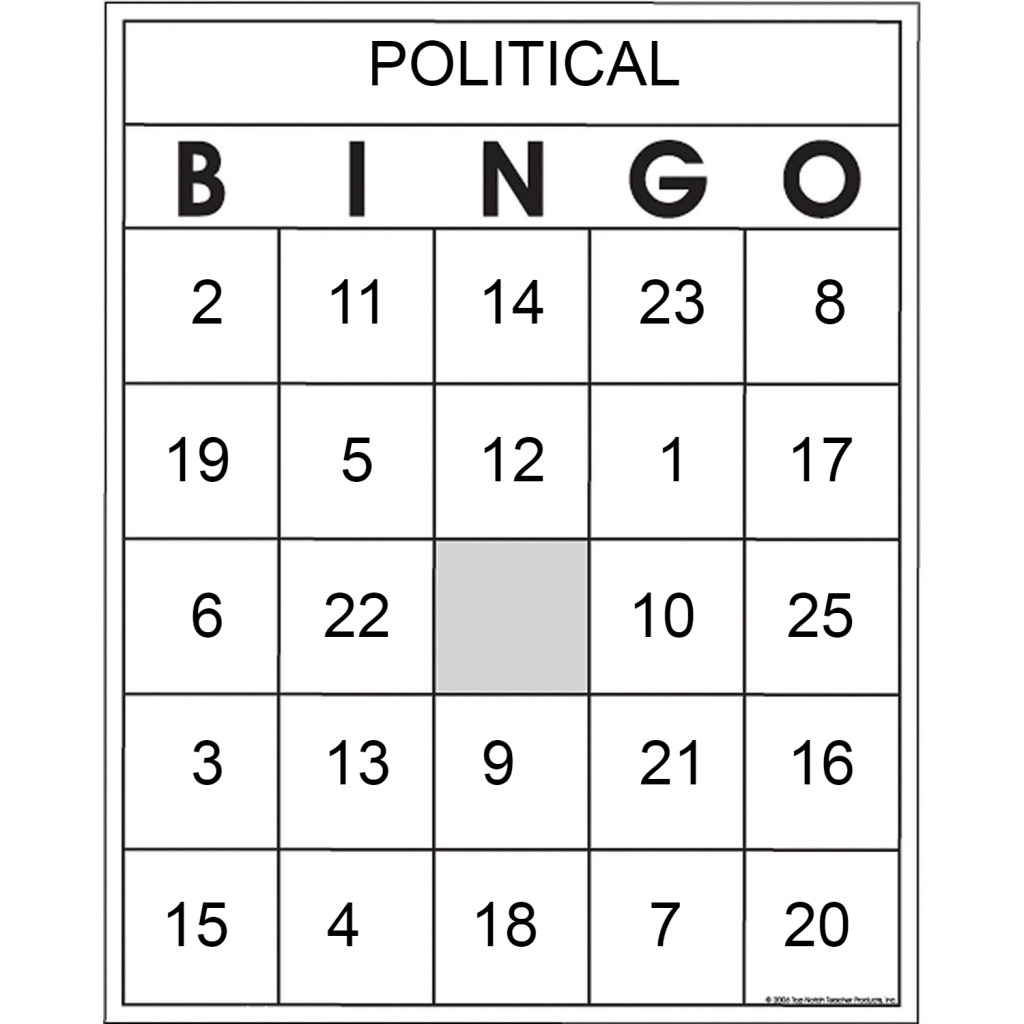
Political Bingo

By Joe Diorio

The 2024 presidential election is underway, as is the proliferation of political jargon we read and hear. Mind you, the offenders of using said jargon are not just news reporters. It’s everywhere. Political pundits and reporters alike are tossing around terms like “War Chest,” meaning money accumulated in advance of a political campaign; RINO, meaning a Republican In Name Only; PUMA, or “party unity my ass;” and “Battleground state” or “Bellweather state,” meaning turf that is either fought over or sure to be won.

Some terms have been around forever. “Plank,” for instance, refers to a position a political party takes on an issue; said position is said to be a part of – or a plank – of the party’s platform. “Taking the gloves off” goes back to the early 19th century and was not originally relating to politics.

The terminology is thrown about so much, and often without thought, that perhaps it is a bit overdone. Just look at a newspaper, a news feed on X, or turn on the evening news and an overdone political term is sure to come up.

I am so confident of this that I have created a game of political jargon bingo. Download and print the Bingo card accompanying this post. Since it is a jpeg picture file you may need to paste it onto a Word or Google document. Also keep the list of 23 political jargon terms. Then keep an eye on the news – print, broadcast, or social media. Every time a jargon term on the list is mentioned, mark the Bingo card. I used numbers because some of the terms are too long to fit on a Bingo card.

When you hear something like “Taking gloves off,” mark the square with #2 because that’s the number corresponding to the term “Taking the gloves off.” Once you get a straight or diagonal line (the center square on the Bingo card is a free space; you’re welcome) you win.

The first three people to fill out their Bingo cards – the first three who do it and tell me about it, I should say – win a signed copy of my book, A Few Words About Words.

Here’s the Bingo card.

And here is the list of jargon.

Political Bingo. How many of these terms have you heard?

1. Gearing up for

2. Taking the gloves off

3. Stump speech

4. Battleground state

5. Bellwether state

6. Coffers

7. Dark money

8. Inside the beltway

9. PAC

10. War chest

11. Wedge issue

12. Flip flopper

13. Lame duck

14. Malarkey

15. Fake news

16. RINO

17. PUMA

18. Pivot

19. Dog whistle

20. Throw their support behind …

21. Balanced ticket

22. Astroturfing

23. Plank

24. Party apparatus

Have fun. And let’s write carefully out there, people.

Joe Diorio is a writer from Fort Myers, Florida. He is the author of “A Few Words About Words” (Beaufort Books, 2021) and the forthcoming “Murders at Trask: Crisis communications and the art of making nothing happen” (Beaufort, 2024)

A curious mark

By Joe Diorio

Let’s talk about semicolons.

Or, as anyone who has struggled with the usage of that curious punctuation mark may say, let’s not.

But like Elizabeth Warren speaking on the floor of the U.S. Senate a few years ago, I shall nevertheless persist.

Personally, I like using semicolons. I suspect my favor of them comes from the same aspect of my personality that prompts me to shave with an old-fashioned straight edge razor and to occasionally wear a bow tie – but not while I’m shaving. There, I said it for you. I do all of that because, well, I can, and I know a lot of people cannot.

But back to semicolons. In my book, A Few Words About Words. A common-sense look at writing and grammar, I write “I even ghostwrote a book for IBM called The Customer-Centered Enterprise; don’t look for it. It’s out of print.” Then five paragraphs later I add, “Who among you caught the fact that I unnecessarily used a semicolon a few paragraphs earlier? Gotcha, didn’t I?”

Well, here’s the rule on semicolon use from The Chicago Manual of Style (15th edition, so it might have changed. I’m too cheap to buy a new edition.) “The semicolon, stronger than a comma but weaker than a period, can assume either role, though its function is usually closer to that of a period. Its most common use is between two independent clauses not joined by a conjunction.”

Yeah, that’s about as helpful as knowing I can properly knot a bow tie.

Writer Kajornwan Chueng (@Siennafrst) writes on X, “The semicolon, like all other symbols, comes with its own psychological effects on the reader’s emotions IMO. Most ppl read fiction to escape, and I always feel a [semicolon,] or a [colon] bring them back to class subconsciously It isn’t pleasant to stumble across when you’re taking a break.” Good down-to-earth reasoning there, for sure.

If you are interested in a deep dive into this curious punction mark, I recommend Semicolon. The Past, Present, and Future of a Misunderstood Mark by Cecelia Watson, who concludes her fun, 183-page book by explaining why the semicolon persists despite some pushback against ever using it. “It’s impossible to confront assumptions we can’t even see,” she concludes.

Punctuation, like language itself, is always evolving. Most punctuation came about as a way to help readers pace themselves, adding emphasis where it is or isn’t needed.

Speaking of punctuation and language evolving, author Amor Towles, in his wonderful book, The Lincoln Highway, does not use a single quote mark in his 592-page book. Instead, he introduces quotes by indenting and placing a dash before the start of the quote. He allows the character dialogue to speak for itself without needing additional clarifications or modifications, forcing the conversation to carry its weight on its own. And, surprisingly, it works.

Now excuse me while I go straighten my bow tie.

Quick hits

It is never too late to correct something. In 2008, right outside of Wrigley Field, the Chicago Cubs baseball team unveiled a statue of Ernie Banks, the Hall of Fame shortstop who hit 512 home runs in his 19-year career. At the base of the statue were the words, “Let’s play two,” an homage to a favorite quote Banks was known to frequently utter. Unfortunately, the inscription was at first missing an apostrophe. The Cubs sheepishly called the sculptor back to correct this error, proving that something can be cast in stone and can STILL be corrected.

We know WHAT happened. ABC News on January 6 was reporting the story of the door plug that fell off an Alaska Airlines Boeing 737 jet while the aircraft was 16,000 feet above ground and climbing. The reporter quoted a Federal Aviation Administration official as saying they were “trying to figure out what happened.” Begging the FAA’s pardon, but we know what happened; a door flew off while the jet was in the air. (See? I just used a semicolon.) What the FAA was probably about to do was figure out WHY it happened. Yes, I’m nitpicking. Sue me.

Exasperation moment. Good advice from @proofreadjulia on X: “Fashion journalists, please cease and desist from ‘teaming’ one piece of clothing with another. While we’re at it, if you ever see me referring to a book as ‘a read’ you’ll know that my account has been taken over by someone else.” Noted.

Let’s write carefully out there people.

Joe Diorio is the author of A Few Words About Words. A common-sense look at writing and grammar (Beaufort Books, 2021) and the forthcoming Murders at Trask: Crisis communications and the art of making nothing happen, also from Beaufort Books.