Spring Training

Making Grammar Cool Again

By Joe Diorio

Everyone can use a workout to stay in shape. (That’s probably the lamest opening line I have ever done, but I’m sticking with it.) So here are a few exercises to tone up our writing.

Proofreading tip. For me, proofreading is the toughest part of writing. “I’ve already written this,” my brain tells me. “There are no mistakes.” Of course, it’s right after I hit “send” on that email when I realize I really wanted to write “duck.”

That said, here is a nearly foolproof proofreading technique:

  1. When you finish what you are writing, stop and play a game of solitaire on your phone. It doesn’t have to be solitaire. Just do something other than look at what you wrote.
  2. Next, return to the document and change the font. Sans serif to serif or vice-versa, doesn’t matter.
  3. Then proofread the document.

This simple procedure works wonders. Changing the font will trick your brain into thinking you are reading a brand-new document and you will inevitably catch mistakes you might not catch otherwise.

Shaking the cobwebs loose. Part I. Regardless* if you are writing a business press release or a passage for your great American novel, we all need to shake our creative juices.

Describe this as though you are an angry motorcycle cop: Opening the windows and letting in fresh air.

Stop laughing. It’s an exercise to stretch your creative juices and NOBODY has to see what you wrote. I have used the Ernest Hemingway quote about first drafts far too often, but just trying an exercise like this works. Try it. Here’s my attempt:

Wasting little time, he ripped the double-hung open like it was an offensive lineman in his way.

Send me yours!

Shaking the cobwebs loose. Part II. If you’re stuck, try changing one aspect of your draft. Writing a scene for a novel? Change the weather. Writing about a new gadget the Trask Company will roll out to the market? In your draft (and I can’t stress this enough – in your DRAFT, not anything you send around for review) write about the new gadget’s global killing effects. Writing about something that is completely off-topic will help you generate fresh perspectives.  
The “est”?

After defeating the Villanova University women’s basketball team to move into the “Elite Eight” of the NCAA Women’s Basketball Championship tournament, University of Miami Coach Katie Meier told reporters, “there is no ‘est’ here. We’re just looking toward the next game.”

Meier’s use of the term “est” is a crazy-shortened version of the word “best.” It’s colloquialism for sure, but it’s one that I admit I hope doesn’t catch on. After all, take away ‘est’ from ‘best’ and you are left with ‘b’ and methinks a shortened word should have enough left to have the original meaning attached to it.

The practice of shortening a word to an idiom isn’t new. Fifteen years ago when the Philadelphia Phillies were winning Major League Baseball championships every year, a popular T-shirt sported the word “ill,” stylized with the same font used in the word “Phillies” uniforms. 

Book News

Mark your calendars for May 2024 (or thereabouts). That’s when my second book, Murders at Trask. Crisis communications and the art of making nothing happen will be published. It is a look at crisis communication planning and is loosely based on a mass shooting event that I, sadly, was in the middle of 40 years ago.

I shall be relentlessly promoting, asking for early reviews, etc. You have been warned.

Let’s write carefully out there, people.

* Yes, I used regardless, not irregardless. (But both are words. Honest.)

The downside of technology

By Joe Diorio

My former employer, Vanderbilt University’s Peabody College of Education and human development (Yes, lowercase “human development.” I forget why that is and – admit it – you don’t give a fig, either.) became embroiled in a ChatGPT debate when a letter about a mass shooting at Michigan State University, a letter written by the AI system but holding a byline of two faculty members, was sent to Vanderbilt students. The authors neglected to remove the last few lines of the letter where there was an acknowledgement that it was the AI system that did the writing.

The “how dare they” outrage over the idea that an impersonal AI tool was used to write about a human tragedy led to the two faculty members stepping down from their assistant dean responsibilities, and Peabody College Dean Camilla Benbow promising a full “how’d this happen?” investigation.

I like my colleagues at Peabody and feel sorry they were in the middle of this brouhaha. But the story for me says a lot about how ChatGPT fits in with our writing toolboxes.

More than once I have been asked, “Hey, you’re a writer. Whaddya think of ChatGPT?” The truth is, I don’t think about it much at all. ChatGPT is a tool. Just like spell check. Just like Grammarly. These tools have their good and bad points.

I still maintain that spell check systems make us bad spellers, because we let the system do the thinking for us. Grammarly can do that, too. (“Affect or effect? Ah, let Grammarly figure it out.” Yes, someone once said that to me.) Sadly, the folks at Peabody had a similar lesson when they let ChatGPT do the thinking. 

If you want to let ChatGPT write something for you, then go for it. But what it spits out should be treated as a first draft. And remember the admonition from Ernest Hemingway, “The first draft of anything is shit.”

Enough said.

“The French?” “The homeless?”

The Associated Press took literal aim at its foot recently, when in a tweet it suggested writers avoid use of the word “the” when speaking about groups. That is, say, “French” rather than “the French.” Or say “homeless” rather than “the homeless.” AP (not “the AP,” I guess) says use of “the” can be dehumanizing. Eventually the AP modified its position, apologizing if its advice was an inappropriate reference to anyone.

Nicholas Kristof used this as an example of how language wars continue, noting arguments over “homeless” versus “people without houses,” or saying “birthing people” versus “women.” Kristof’s op ed takes a look at language in its role in culture wars. It’s a good read.

Word of the moment

Kudos to Mike Tannenbaum, former general manager of the New York Jets and current football analyst for ESPN. On a February 21 episode of the morning sports talk show Get Up Tannenbaum used the word “prolificity,” generating a wave of playful ribbing from his TV coworkers and causing one newsletter editor to turn to the dictionary. Well, prolificity is a noun, referring to power or character, and Tannenbaum was talking about the power and influence some NFL players can have. Well played, Mike T.

Subject/noun agreement anyone?

I heard the following in a local TV news story, “A bullet was found in a driveway the size of a quarter.” All I can say is, man that is one small driveway. Let’s write carefully out there, people.

Come on, man!

By Joe Diorio

I resist picking on grammatical errors committed by anyone in the news business. I worked in that field, and I know whatever is written – be it for print or broadcast – is often done at the eleventh hour, a term that is defined as something being done at the latest possible moment before it is too late. That’s a ripe environment for making mistakes.

Despite this reluctance, a few grammatical miscues by print and broadcast news outlets landed in my in-box and I’m feeling the need to share.

From NBC4 in Washington, D.C., on January 20: “The family of a D.C. teacher who died in police custody is suing Los Angeles police for $50 million, and placing bets at FedEx Field.” Welp, they probably had a good financial settlement. But I thought placing bets at National Football League venues, which is what FedEx Field is, was illegal. Oh, well.

From a daily briefing email by The (Fort Myers, Florida) News-Press: “Gov. Ron DeSantis pushing for permanent ban on COVID-19.” So, all it took was a ban?

From a local ABC affiliate on January 6, reporting that the pier in Naples, Florida was severely damaged during a hurricane. “Two-hundred feet of the pier are missing,” said the reporter covering the story. The use of the word “are” in this case rubbed my eardrums the wrong way. The pier is one thing, and it is a specific number of feet in length, just as I am a specific number of feet and inches in height. Sadly, because of severe back problems I am no longer as tall as I once was, but I don’t say, “an inch and a half of me are missing.” Similarly, because of the hurricane, one should say 200 feet of the pier IS missing. Fight me.

And just to show I am not the only editor whose hackles get up in a ruffle over language, @juliaproofreader on Twitter offered the following advice (admonition?) on January 23:

“Magazine fashion editors! Please don’t use the ghastly hackneyed phrases:

  • ‘Opt for’ – IRL, nobody ‘opts for’ anything.
  • ‘Team’ i.e. ‘teaming’ one item of clothing with another.
  • ‘Toasty’ – absolute worst offender, to describe the condition of keeping/making one warm. (imagine a puke emoji right here).

Cheese-it, the grammar police!

Last month’s note about forming the plural of the snack Cheez-Its by saying “Cheez-It Crackers” rather than “Cheez-Its,” prompted a question from one reader, “Does anyone say ‘Cheese it, the cops’ anymore? Or is it confined to old movies aired by TCM (Turner Classic Movies).”

Saying “Cheese it, the cops” was used as a clarion call by the bad guys to run away because the police are closing in on whatever nefarious activities they are up to. Saying “Cheese it” may be a corruption of “cease,” as in “stop what we’re doing,” but according to thefreedictionary.com the exact etymology isn’t known. BTW, anyone notice I just used “nefarious,” “clarion call,” and “etymology” all in one paragraph? I’m loving this passage, people.

Drop me a note if you use the term or hear it used in everyday conversations.

Will somebody please fix that drip?

The discovery of government classified documents at Mar-A-Largo, Joe Biden’s house in Delaware, Mike Pence’s house in Indiana – has anyone checked Oprah’s house? Just asking. – brought about the ear-rattling term “drip-drip-drip” in news stories. It is news jargon at its worst, referring to bite-size pieces of news about a story becoming public very slowly. The use of the term was pervasive enough for a video skit on The Late Show with Stephen Colbert on January 23.

I first encountered the term in the mid-1970s when the Presidential Administration of Richard M. Nixon was embroiled in a cover-up pertaining to a break in at the Democratic National Committee headquarters in the Watergate Hotel. The question dripping away at the news then was, “what did the President know and when did he know it?” I’m just wondering if anyone has counted how many times the term “drip-drip-drip” has been used?

Let’s write carefully out there, people.

It’s Festivus! Come to the keyboard to complain.

By Joe Diorio

The New Year (yes, it is capitalized) marks time for the grammatical celebration of Festivus, where we gather around the keyboard and share our pet peeves.

Sometimes I wonder if there will be enough content for a good Festivus edition. Then the internet smiles upon me and “irregardless” trends on Twitter. Yep, nearly 3,000 tweets in a single day on Thursday, December 15.

“Irregardless is not a word. Just use regardless. Thank you for listening to my TED talk,” writes @RandomIgnorance.

“Irregardless, I hate it when someone writes “loose” but means “lose” says @PericaErica.

“As irregardless is trending, may I also take this opportunity to remind you that the correct phrase is COULDN’T care less. To say, ‘I could care less’ implies that you ACTUALLY F___ING CARE,” say@DDRey.

“Many people find irregardless to be a nonsensical word, as the ir- prefix usually functions to indicates negation; however, in this case it appears to function as an intensifier,” writes @JAMESEDSTROM

I have discussed this before, but once more (with feeling) … irregardless is a word. It has been a part of our language for over 200 years. Merriam-Webster defines irregardless as “nonstandard” meaning same as “regardless.” It also advises us to use “regardless” instead.

Now let me duck before you start throwing blunt objects around.

From the “Aw, you know what I mean” department

Item #1: Writing to a colleague at Northampton Community College in Pennsylvania, Jon Jay DeTemple, president of Harcum College in Bryn Mawr, Pennsylvania (mea culpa, I used to work there) asks, “Could we get away from using the term “school?” [M]ost do say ‘college.’ For years we have fought the perception that we are just an extension of high school. Let’s upgrade and use the generic ‘college’ in our communications.”

DeTemple’s desire for us to view Harcum as an institution of higher education is a struggle community colleges and junior colleges sometimes face. The effort exists inside and outside the college. A coworker at Harcum once said to me, “What’s the difference between senior year in high school and first year of college? Two months.”

For anyone who is wondering, a college represents a field of study – a college of liberal arts, or engineering, or law, etc. whereas a university is a collection of colleges. Now you know.

Item #2: The phrase, “I’ll print that out for you” is my personal fingernails on a chalkboard. A “printout” is a noun, referring to something that just came out of a printer. If you are sending something to a printer, then you are simply printing it.

Item #3: Honoring Franco Harris. “What’s ESPN thinking?” wrote one reader in late December. “They said they are ‘honoring’ the death of Franco Harris! Are they happy he’s gone?”

The writer of that email is referring to the former running back for the Pittsburgh Steelers of the National Football League, who died suddenly at the age of 72. The ESPN utterance the writer took umbrage to was, “We honor the death of former Steeler Franco Harris.”

Use of the word “honor” as a verb in this case is probably something we all do. It means “regard with great respect.” If someone is being picky, like the person who wrote to me, then saying you “honor his death” means you are showing respect to the fact that someone has died, which is probably not what you mean. A more accurate sentence would by that you honor the career of the late Franco Harris.

Nothing will cheese you off like pluralization

Irregardless isn’t the only term lighting the internet on fire. As the University of Oklahoma and Florida State University prepared to square off in the Cheez-It Bowl on December 29, the company that makes the salty, cheesy snack shook the Twitter tree when it said the plural of Cheez-It is NOT Cheez-Its, but rather “Cheez-It crackers.”

Fans were, not surprisingly, cheesed off.

“Everyone who has ever stuffed their face with those sharp, four-cornered morsels has referred to them as Cheez-Its. Because they are Cheez-Its,” wrote one fan. “Hell, if someone called them ‘Cheez-It crackers’ you’d probably ask them to leave your house. Or at the very least wonder silently about what chain of events in their life sent them down such a troubling path.”

Other than Xerox successfully convincing people to stop referring to a photocopy as a “Xerox,” corporate efforts at managing language face an uphill battle.

Some good stuff to close

Big thumbs up to writers at some Fort Myers, Florida television stations.

First, the crew at the NBC affiliate on December 13 reported on a rat infestation at a local Walgreens (yes, I said rat infestation – don’t ask) and, playing off an advertising slogan the pharmacy uses, they wrote, “This is not the corner of happy and healthy.”

Second, the meteorologist at the CBS affiliate on December 28 nailed the use of “literally” (an overused and overhyped word) when he reported on Southwest Florida’s fair weather by Tweeting, “It’s literally perfect out!”

Third, the ABC affiliate on December 29 aired a story about a truck carrying pigs overturning on a highway near Las Vegas, saying, “It’s now swine city.”

Kudos, everyone.

Let’s write carefully out there, people.

Online or in person writing tutoring available. Dates are available for the first quarter. Contact me for details.

Happy Holidays from me

By Joe Diorio

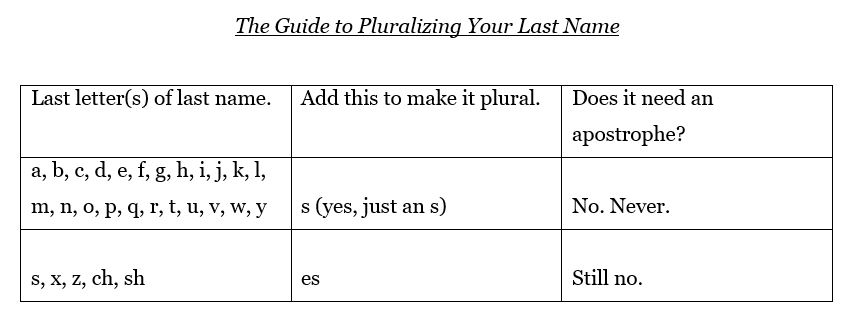
Holiday cards are a “to do” on many people’s 2022 year-end list. So, it’s time for an old favorite: the guide to properly pluralizing one’s last name.

It’s way easier than it seems. Just add an “s.” That’s it. No apostrophe, no special symbols. Just add an “s.”

As simple as it seems, my delivery of cards this time of year indicates otherwise. Remember, writing “Happy holidays. We love the Diorio’s” makes one ask, “Love the Diorio’s … what?” since the apostrophe and the letter “s” indicate possession of something. But rather than getting myself tied up in knots explaining things, here is the popular guide to pluralizing your name.

It’s Season in Southwest Florida

One Southwest Florida term that is lodged in my brain comes from a headline in the November 7 edition of the News-Press that read, “What will season bring in Southwest Florida this year?” The word “season” is a noun, and the headline reads as though the word needs a modifier, like tourist season, winter season, etc. I asked the reporter who wrote the story about the term. She explained it is a local idiom generally referring to fall and winter when tourists and “snowbirds,” or people who own a home up north, return to Southwest Florida to escape the winter cold.

The use of “season” as a shortened, aw-you-know-what-I-mean version of “tourist season” is a form of truncation. For example, the word “microphone” is shortened to “mic.” Fans of the National Football League’s Cincinnati Bengals truncate the word “they,” saying “dey,” as in “Who dey think is going to beat the Bengals?” Cincinnati broadcast sports reporter Sara Elyse truncates it even further. When the Bengals played the Titans on November 27 she Tweeted, “It’s a great DEY for the Bengals to beat the Titans.” All this shows that language is influenced largely by where you are standing at the time.

New words for Scrabble

Good news Scrabble fans. There are now 500 new words available for use with the popular board game. Among the new words (many of which we have used for some time) are “guac” (short for guacamole), “zedonk” (a hybrid between a zebra and a donkey), and “Jedi” (and we can’t be friends if I have to define this one).

One of the new words available for Scrabble is “gaslighting,” which Merriam-Webster also dubbed the 2022 word of the year. Gaslighting is defined as mind manipulating, grossly misleading, or downright deceitful. It’s worth 17 points in Scrabble, but I personally find it sad that, for two years in a row, words with potentially negative connotations have become the word of the year; the 2021 word of the year was “vax,” as in vaccination. 

When in doubt (read my book)

“Is it re-open or reopen?” someone asked via Twitter recently. For me, this is an easy one. It’s reopen, so says Merriam-Webster and Oxford. Like I say in my book, I don’t automatically know this stuff. I just look it up.