My Blog

Surviving a word tsunami

WordTsunami

By Joe Diorio

In 1985 IBM gave each of its 430,000 employees a business card-size document listing all the company holidays (New Year’s Day through to Christmas) for the coming year. This was pre-internet so there was no web page for that information. Everyone who worked for the company, therefore, could look at this card and see that one of the holidays for the upcoming year was Thanksgiving, which would be on THURDSAY, November 27.

Ow.

Typos happen to all of us. Sometimes they’re more prominent than others. “It’s you versus a tsunami of words,” a supervisor once told me. “Eventually, one that’s spelled wrong is going to get past you.”

We should all have such an understanding manager. Today there is texting, social media, and 24-hour news cycles so that tsunami of words is bigger than ever. We need a plan to proofread our writing. Here’s one systematic way to do that.

For starters, the moment you finish writing something put it aside. Time is your friend, even if a deadline is breathing down your neck. Play a round of solitaire on your smart phone. Anything other than looking at what you wrote. Sandie Giles, author of How to Proofread Your Own Writing, says impatience and familiarity are two factors that are detrimental to your ability to proofread. A bit of separation can help you catch that errant mistake.

Next, plan on reading your document at least four times, looking for specific things each time. Do not just say “I’ll carefully proofread it.” HOW will you do the proofreading? A plan spells out several reads you should do for your document and identifies what you will read and what you should look for.

First pass – misspellings. A colleague who worked for the Associated Press said he reads with the assumption that every word is misspelled. While you may not have to be that xtreme (See what I just did there?) focus exclusively on how each word is spelled.

Second pass – punctuation. Do you have the period or other punctuation inside or outside quote marks? (Hint: they go inside.) Is that semicolon necessary, or can you break the sentence in two? Quick mea culpa. I love using semicolons. It makes me think I’m smarter than I really am.

Third pass – formatting. A generation ago Strunk and White in The Elements of Style advised us to “choose a suitable design and hold to it.” Are any subheads you use formatted consistently? Is each paragraph indentation the same? In lists do you use bullets or numbers? And in those lists are you using parallel construction with an action verb to start each point (as in “build,” “wait,” “stop,” etc.)?

Fourth pass – have someone else read it. I have several friends and colleagues who proofread my monthly newsletter, A Few Words About Words, to be sure it’s right. And occasionally mistakes do get through.

Professional communicators put a lot of effort into their messages. How those messages are proofread is the final step to make our work successful.

Let’s write – and proofread – carefully out there, people.

(Joe Diorio is a freelance writer living in Nashville, Tennessee. You should tell your friends and colleagues about him.)

Join my mailing list. My monthly newsletter is free and I never sell lists.
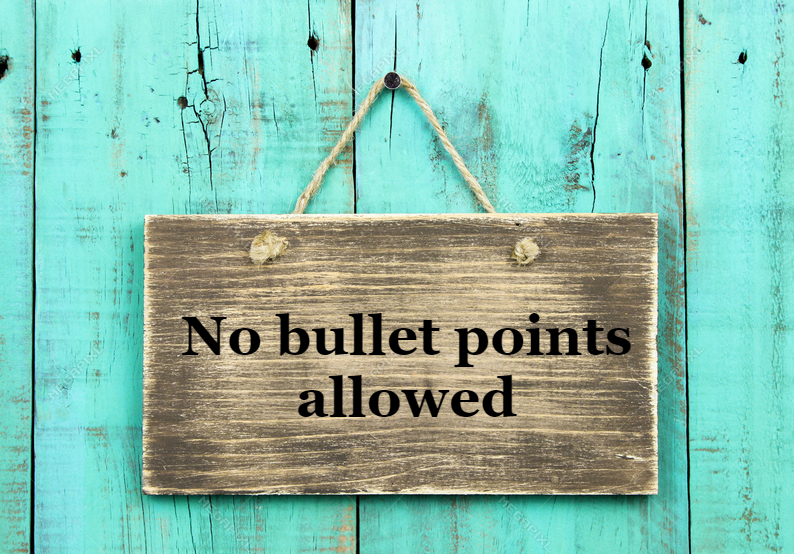
No bullet points allowed

No bullet points allowedVeteran advice on the new world of speeches
By Joe Diorio

I worked for a time as a speechwriter for a pair of executives at IBM. One was a very good speaker. The other? Well, he was otherwise good at his job.

The good speaker rarely used slides and kept his talks to 20 minutes or less. The other? I once had to create a slide to explain a previous slide in one of his presentations. And he routinely needed at least 10 minutes just to introduce himself.

Point made. Public speaking is hard. And it is only getting harder in a social media world. Apple recently said it limits executives to ten minutes for a speech. And a wonderful presentation from Google doesn’t use a single bullet point. Clearly the rules of public speaking are changing.

Some speechwriters have sound advice on making good presentations in today’s social media world.

“I follow the ‘10/20/30’ rule. Ten slides to present in 20 minutes and nothing smaller than 30-point type on the slides,” says Thomas Mattia, a former executive who ran communications for Coca Cola, Yale University, Electronic Data Systems, and Ford Motor Company. “You have to make your points as convincing as possible in the shortest amount of time.” He teaches a storytelling class at Rutgers University and has students follow the 10/20/30 rule.

The message and good writing are the primary concerns for another veteran speechwriter. “A picture may be worth 1,000 words, but a picture of 1,000 words is worthless,” notes Boe Workman, director of CEO Communications for AARP. Workman is firm in his belief that the slide is not the speech.

Liz DeCastro, executive director of marketing communications and events for the National Council on Compensation Insurance (NCCI), says she has a team who works on developing images that support rather than repeat a speaker’s message.

“I once sat in on a presentation on a very technical subject,” DeCastro says. “The speaker used no notes, and the images supported – not repeated – what he said. I always try to take that approach myself.”

Workman said the length of a speech is secondary to the quality of writing. “I don’t buy that a 10-minute speech is hard to do,” he says. “People can’t listen to a five-minute speech if it’s not written well. If well written, then the audience will be mesmerized by it.”

Odds and ends

I tend to give broadcasters more than their share of mulligans, but I couldn’t let pass the bromance that networks and local affiliates alike have with using the word “facility” during reporting of the delivery of pipe bombs to high-profile Democratic party members and their supporters. “Mail facility,” “bomb disposal facility,” “investigation facility.” Gloriosky, folks, how about “post office,” “safe disposal site,” and “crime lab.” I figured the sports report would be all clear, but Nissan Stadium, home of the Tennessee Titans of the National Football League was referred to as a – you got it – “sports facility.”

Lastly, lest no one thinks I only pick on broadcasters, the New York Times, in a preview story about the World Series between the Boston Red Sox and the Los Angeles Dodgers, said “Beat! L!A! are the three most famous letters in Boston.” Really? What’s the third letter?

Let’s write carefully out there, people.

Dull writing = bad marketing

wordsalad

By Joe Diorio

Dull writing, in an age when we seem to spend less and less time looking at the written word, is the proverbial kiss of death for marketing communication professionals trying to carve out a niche for their companies or clients.

Almost a decade ago Nicholas Carr asked the question in The Atlantic magazine, “Is Google making us stupid?” He discussed the scan and graze nature of reading in the age of instant information. “[The] Net seems to be […] chipping away at my capacity for concentration and contemplation,” he wrote.

In the ensuing years social media seems to have done to prose what Google may have done to reading. The demand for quick and up-to-the-nanosecond communication is leaving good writing in its wake. A quick scan of my news feeds on Twitter and LinkedIn shows the text in each post possesses the same banal monotony.

  • “We are so proud …”
  • “Today I had the chance to …”
  • “This is super interesting …”
  • “Humbled by my introduction to …”
  • “Excited to announce …”

People, people, please stop! We can do better.

OK, so writing and grammar are ever evolving. Fans of William Safire’s “On Language” columns in the Sunday edition of The New York Times understand this. Also, there is a lot of pressure to produce content. Jayson DeMers writes in Forbes, “The growth of the internet means that everyone is publishing more content than ever […] the sheer volume of social media posts, articles, blog posts, images, videos, and more means that there’s that much more potential for error.”

Still, we need good writing when people spend less time reading. Is there a solution? Yep. “Omit needless words” advises The Elements of Style. Each of those introductory lines cited above can and should be axed. We know you’re proud, excited, and humbled. Tell us WHY you are that way.

Ted Sorensen, who I had the privilege of meeting in 2009, gives the same advice, but with more style than I can muster. (I’ll shorten his advice since we’re all reading this online.)

He said a salesman was setting up shop to sell seafood. First pass at a sign: “Fresh Seafood, Fish for Sale.” Well, the salesman thought, who would sell stale fish? He shortened the sign to “Seafood, Fish for Sale.” Heck, fish are seafood, so the word “fish” was dropped. But if I’m selling seafood in a store why say it’s for sale? The final sign outside his store read, simply, “Seafood.”

And, by the way, I’m confident he was proud, excited, and humbled by the chance to open his store.

Let’s write carefully out there, folks.

Joe Diorio is a writer living in Nashville, Tennessee. You should tell your friends and colleagues about him.

BONUS: Hootsuite offers a list of Twitter feeds exemplifying good writing.

Call for networking! Because you really don’t know who knows who.

               Networking2

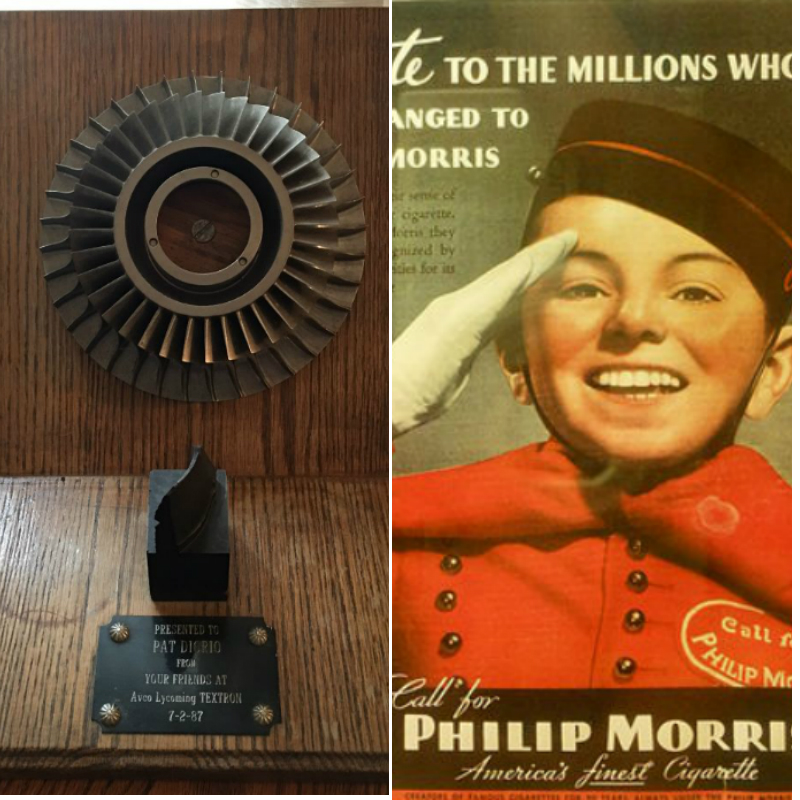
Above, left, an impeller for the engine of an M-1 tank (Dad designed the tooling to mass manufacture that). Above right, the Philip Morris bellhop.

My father, a career tool-and-die maker who never moved far from his hometown of Bridgeport, Connecticut, and an advertising icon from Philip Morris, taught me the value of business networking. Their lessons are spurring me on again.

I retired from full-time work recently, and decided to keep myself busy by offering my services as a copy editor and proofreader. (I successfully freelanced from 1991 to 2000.)

One-by-one I am writing to all my LinkedIn connections. Yep, all 2,000 of them. Each person is getting a short email saying (1) what I am now doing, (2) stressing that I am NOT pressuring them for work, and (3) instead, asking if there is anyone they think I should introduce myself to.

Granted, not all my LinkedIn contacts are active. Some don’t know me very well. And I already know some will wonder why I am writing to them. “We’re in the same business,” one freelancer wrote back. “I couldn’t really recommend you to anyone.”

Contacting so many people is a huge undertaking, but I do it for one simple reason: You don’t know who knows who.

When I first left a full-time job to become a freelance advertising copywriter, I was explaining to my father what I’d be doing for a living. My wife and I were expecting our first child and leaving full-time work at that moment didn’t strike Dad as the smartest move.

But after explaining what an advertising copywriter does, Dad offered one suggestion: “Would you like me to introduce you to Johnny Roventini?”

You are probably thinking the same thing I was. “Who is Johnny Roventini?” Turns out he was an advertising icon. Beginning in the 1930s, Roventini worked for the Philip Morris company, appearing in a series of movie house commercials. He’d be dressed as a bellhop, walking through the lobby rhythmically shouting the phrase “Call for Philip Morris!”

This was an exceptionally successful advertising campaign. Roventini appeared in many commercials and in his later years he worked as a good will ambassador for Philip Morris. He was, in effect, the precursor to the Maytag repairman.

He also knew my Dad.

I never personally met Roventini, nor did I do any work for Philip Morris. But after Dad “referred” me to him Roventini did pass my name long to people with the Madison Avenue advertising agencies that worked with Philip Morris, and sooner than I would have thought I had freelance writing assignments from them for consumer electronic products.

So I don’t fret when one of my notes gets a “why are you writing to me?” response. Even that freelancer who wondered why I was writing to her DID suggest a few places I could go and introduce myself (and none of them involved jumping in a lake). You never know who knows who.

Join my mailing list!