My Blog

A Celebration of Festivus, Part III

By Joe Diorio

Based on reader feedback I am learning that the grammatical celebration of Festivus, where we air our grievances about language, should not be confined to one month of the year.

Case-in-point: Don Block teaches English at Montgomery County Community College in Blue Bell, Pennsylvania (just outside of Philadelphia). He is a self-described complainer and after reading A Few Words About Words. A common-sense look at writing and grammar decided to share his own list of pet peeves.

  • “I’m like” plus a sound effect or occasionally a word.
  • “Let’s do this.”
  • Any use of “this” when this word does not directly precede a noun.
  • “Reach out” instead of “contact,” “write to,” or “talk to.”
  • “Conversation” when it’s used instead of “discussion.”
  • “Conversate” (Possibly because it is used incorrectly … it is an intransitive verb … yes, I checked.)
  • Any use of “leverage” to explain something that does not involve a fulcrum.
  • The use of “their” to refer to a singular antecedent: “Be prepared to politely and respectfully disagree when the client trashes your efforts to explain their jargon….” (OK, this one might get some pushback. “Their” is an indefinite third person singular antecedent, as in “Anyone in their senses.” It is a good example of language evolving and we cuss and discuss said evolution.) 
  • Using at least two pronouns to refer to a singular antecedent: “he or she” or “she or he” is a lot of she-he-it. (Clever Don. Very clever.)
  • Using “grow” as a metaphorical transitive verb, as in “Grow your business.”
  • “This is not my first rodeo.”
  • Using “in terms of” or “moving forward,” usages that point to dead areas in the brain of a speaker who feels compelled to keep talking. 
  • “Synergy,” a great bullshit word.
  • “It is what it is.”
  • Using “Dan” when it should be “Don.”

The last item on his list is my fault; I apparently have a bone in my head that forces me to call him Dan. Regardless Dan, er, Don, I do appreciate the feedback. 

Holy oversight, monsignor.

An old joke about language goes like this: A classified advertisement in the daily newspaper (yes “classified advertisement;” I told you this is an old joke.) contained the following:

“ATTENTION: Everyone who purchased our ‘Skydiving Made Easy’ correspondence course, please take note. On page 17 you should change the text from STATE ZIP CODE to PULL RIP CORD. Thank you.”

The crux of the joke is that words matter. Anyone who was baptized or had a child baptized by Father Andres Arango at St. Gregory parish in Phoenix, Arizona feels seen.

For years Father Arango was using the wrong word when baptizing babies. He was saying “WE baptize” you rather than the accepted “I baptize you.” This seems like an eensy weensy oversight, but from the standpoint of the Catholic Church it has invalidated scores of baptisms and subsequent sacraments like confirmation and marriage.

Even though Catholics understand the “Father, Son, and Holy Spirit,” making the thought of using “we” seem acceptable, it isn’t, according to a Vatican spokesperson. “The issue with using ‘We’ is that it is not the community that baptizes a person, rather, it is Christ, and Him alone, who presides at all of the sacraments, and so it is Christ Jesus who baptizes,” the spokesman explained.

Here’s hoping that Father Palucci said the right word as he baptized Pat and Gerry’s little boy 66 years ago …

A grocer’s apostrophe

Here is a new way to misuse an apostrophe, shared by Emily Haag, a proofreader and editor in the United Kingdom.

A grocer’s apostrophe is the name given to an apostrophe when used to form a plural, as in apple’s, pear’s, and orange’s. It’s a common mistake, she explains.

“It’s quite common,” she explains in a post on LinkedIn. “It can happen easily by accident because we’re so used to putting apostrophes before the letter S.”

In this case the correct use would be to indicate possession, as in “The apple’s stalk …” or “the pear’s skin.” Not sure why it is called a grocer’s apostrophe, other than it may be most frequently used when talking about produce.

AN IMPORTANT NOTE FROM THE EDITOR

A Few Words About Words will, in June 2022, transition to an online blog rather than a monthly email. I would appreciate retaining all my readers, so please visit my website and click “Follow,” which can be found in the lower right-hand corner of your screen. Then again, if you are reading THIS, then you are at my website.

And remember. Let’s write carefully out there, people.

Joe Diorio is a writer living in Nashville, Tennessee. His first book, A Few Words About Words, is available now.
Festivus for news pros

By Joe Diorio

The editorial page of the San Gabriel Valley Tribune in Monrovia, California on January 4 carried a headline reading “2022 brings a slew of new state laws.” I don’t know if Vince DeFruscio is a reader of the San Gabriel Valley Tribune. He probably isn’t, since he lives in Philadelphia, but I am sure his skin would crawl if he saw that headline.

DeFruscio is an executive producer with Fox 29 News in Philadelphia. Earlier this year he posted a query on his Facebook page, asking his followers to nominate overused words in the news business.

“I used to think it was ‘iconic,’ but now I think ‘slew’ is the most overused word in TV news,” he wrote. His musing produced a slew of responses.

“Brazen has to be pretty high up there,” one friend boldly and without shame wrote (see what I did there?).

Writing under deadline can generate a considerable amount of common and even repetitive language and terminology. When it is 3:30 p.m. and you are writing a TV news script for a 4 p.m. broadcast you may need more than one way to describe a highway car accident, house fire, or a situation of someone being robbed. So, knowing that writing for TV news ain’t the easiest thing to do (yes, ain’t is a word; don’t “@” me, people) I offer a sampling of the comments DeFruscio’s post generated.

  • “No more ‘black smoke billowing,’ and there’s no reason to write ‘completely destroyed.’” If it is destroyed, it IS completely destroyed.”
  • “I hate ‘rash.’ A ‘rash’ of carjackings …” Besides being a skin condition (noun), rash is used here as an adjective. In that form its definition is something proceeding a lack of careful consideration. But in the complainant’s comments they are talking numerous instances of a crime. So, in this case, not only is it overused, its brazenly wrong.
  • “How about ‘a flight into fear!’ and ‘pack your patience’.” There is a Cape Fear in North Carolina, but I have no idea how to fit patience into a carry-on bag.
  • “Something increases your chances of dying. Welp, last I heard it’s a 100% guarantee none of us gets out of this world alive.”
  • “I punch myself in the face for ‘shots rang out’.”
  • “Very unique.”
  • “Shocking,” “efforting” (that’s verbing a noun), and “a violent attack.”
  • “Negotiators have reached a STUMBLING BLOCK. Ok, go to Home Depot and ask for a stumbling block and see what they bring out.”
  • “If I have to hear another script begin with, “It wasn’t your typical {day of week} …”
  • “Arson fire” (straight out of the department of redundancy department).
  • And the one that makes my skin crawl, “facility.”

DeFruscio promises to circulate his list to every news professional he knows. It should last until it’s time for politicians to take the gloves off.

Wordle? I think not.

Despite having a street rep as a word person, I have not played Wordle. To be brazenly honest (sorry, couldn’t resist that one) I don’t plan to, either.

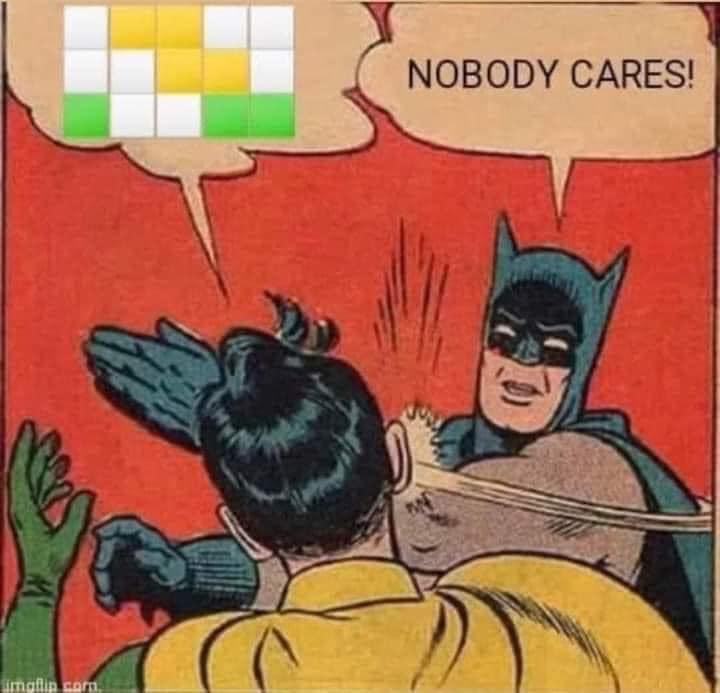
For anyone wondering why those green and yellow blocks keep showing up in our social media news feeds, Wordle is an online game that launched in October. Players must guess what a five-letter word is. The challenge is to get the word right in as few moves as possible. Once finished playing, you can post your results to social media. About two million persons worldwide play Wordle every day.

According to social psychologist Matt Baldwin, a University of Florida professor, Wordle catches our fancy for several basic reasons; it gives us a daily “aha” moment, even if we get the word wrong; it suits our need for control in a pandemic-fixated world; it provides a sense of community; and it (sorta) isn’t addictive since you can only play once a day.

My own lack of interest is on two levels. One, I don’t play puzzle games. I used to try my hand at crossword puzzles, but I would leave them feeling more annoyed than satisfied. (“How the heck many times can you use ‘epee’ as a word!”). Also, Wordle reminds me of Wheel of Fortune on TV and I stink at that game, too. But Wordle isn’t going anywhere. On January 31 The New York Times purchased the online game for a price somewhere “in the low seven figures,” according to a story in The Washington Post. The Times looks for Wordle to help strengthen its online presence, since fewer and fewer of us are buying a print copy of the daily newspaper.

Joe Diorio is a writer from Nashville, Tennessee. He is the author of A Few Words About Words. A common-sense guide to writing and grammar, which is available wherever fine books are sold.