Political Bingo

By Joe Diorio

The 2024 presidential election is underway, as is the proliferation of political jargon we read and hear. Mind you, the offenders of using said jargon are not just news reporters. It’s everywhere. Political pundits and reporters alike are tossing around terms like “War Chest,” meaning money accumulated in advance of a political campaign; RINO, meaning a Republican In Name Only; PUMA, or “party unity my ass;” and “Battleground state” or “Bellweather state,” meaning turf that is either fought over or sure to be won.

Some terms have been around forever. “Plank,” for instance, refers to a position a political party takes on an issue; said position is said to be a part of – or a plank – of the party’s platform. “Taking the gloves off” goes back to the early 19th century and was not originally relating to politics.

The terminology is thrown about so much, and often without thought, that perhaps it is a bit overdone. Just look at a newspaper, a news feed on X, or turn on the evening news and an overdone political term is sure to come up.

I am so confident of this that I have created a game of political jargon bingo. Download and print the Bingo card accompanying this post. Since it is a jpeg picture file you may need to paste it onto a Word or Google document. Also keep the list of 23 political jargon terms. Then keep an eye on the news – print, broadcast, or social media. Every time a jargon term on the list is mentioned, mark the Bingo card. I used numbers because some of the terms are too long to fit on a Bingo card.

When you hear something like “Taking gloves off,” mark the square with #2 because that’s the number corresponding to the term “Taking the gloves off.” Once you get a straight or diagonal line (the center square on the Bingo card is a free space; you’re welcome) you win.

The first three people to fill out their Bingo cards – the first three who do it and tell me about it, I should say – win a signed copy of my book, A Few Words About Words.

Here’s the Bingo card.
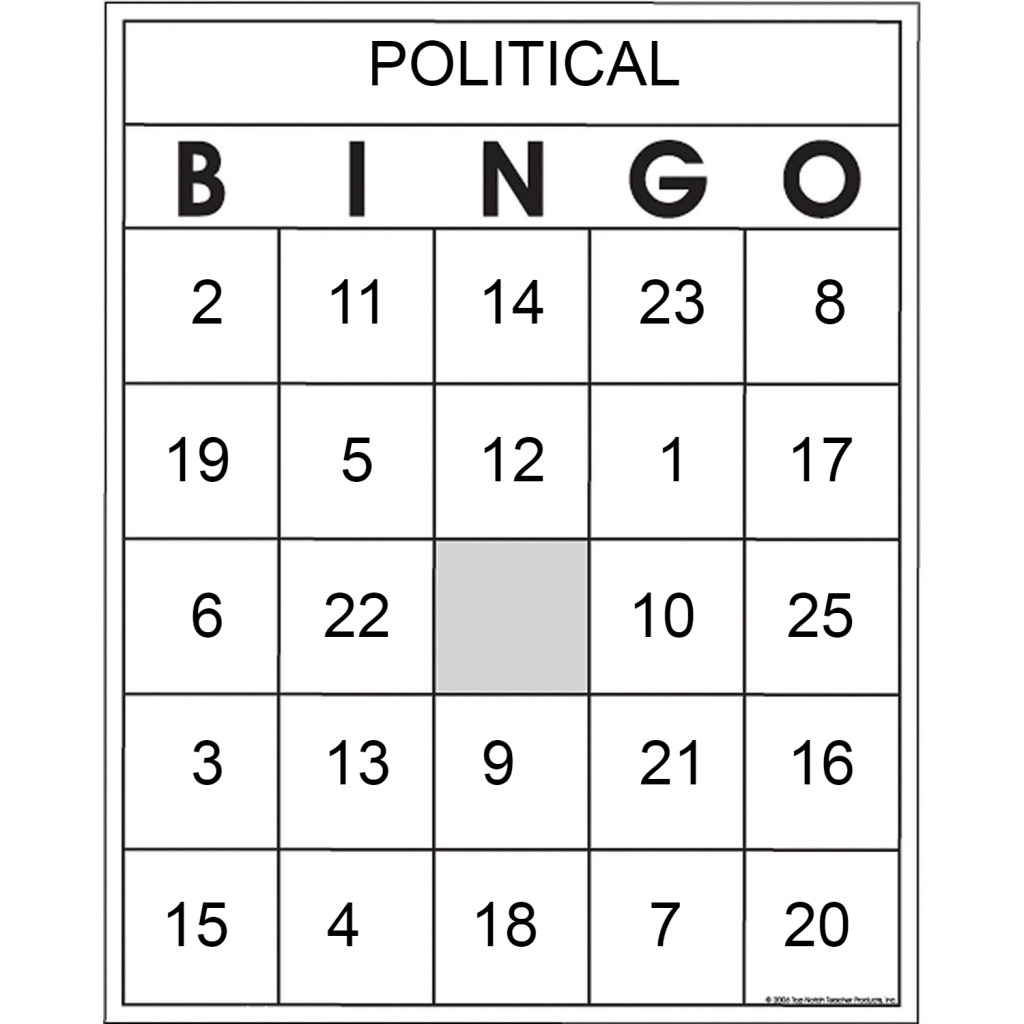
And here is the list of jargon.

Political Bingo. How many of these terms have you heard?

1. Gearing up for

2. Taking the gloves off

3. Stump speech

4. Battleground state

5. Bellwether state

6. Coffers

7. Dark money

8. Inside the beltway

9. PAC

10. War chest

11. Wedge issue

12. Flip flopper

13. Lame duck

14. Malarkey

15. Fake news

16. RINO

17. PUMA

18. Pivot

19. Dog whistle

20. Throw their support behind …

21. Balanced ticket

22. Astroturfing

23. Plank

24. Party apparatus

Have fun. And let’s write carefully out there, people.

Joe Diorio is a writer from Fort Myers, Florida. He is the author of “A Few Words About Words” (Beaufort Books, 2021) and the forthcoming “Murders at Trask: Crisis communications and the art of making nothing happen” (Beaufort, 2024)

A curious mark

By Joe Diorio

Let’s talk about semicolons.

Or, as anyone who has struggled with the usage of that curious punctuation mark may say, let’s not.

But like Elizabeth Warren speaking on the floor of the U.S. Senate a few years ago, I shall nevertheless persist.

Personally, I like using semicolons. I suspect my favor of them comes from the same aspect of my personality that prompts me to shave with an old-fashioned straight edge razor and to occasionally wear a bow tie – but not while I’m shaving. There, I said it for you. I do all of that because, well, I can, and I know a lot of people cannot.

But back to semicolons. In my book, A Few Words About Words. A common-sense look at writing and grammar, I write “I even ghostwrote a book for IBM called The Customer-Centered Enterprise; don’t look for it. It’s out of print.” Then five paragraphs later I add, “Who among you caught the fact that I unnecessarily used a semicolon a few paragraphs earlier? Gotcha, didn’t I?”

Well, here’s the rule on semicolon use from The Chicago Manual of Style (15th edition, so it might have changed. I’m too cheap to buy a new edition.) “The semicolon, stronger than a comma but weaker than a period, can assume either role, though its function is usually closer to that of a period. Its most common use is between two independent clauses not joined by a conjunction.”

Yeah, that’s about as helpful as knowing I can properly knot a bow tie.

Writer Kajornwan Chueng (@Siennafrst) writes on X, “The semicolon, like all other symbols, comes with its own psychological effects on the reader’s emotions IMO. Most ppl read fiction to escape, and I always feel a [semicolon,] or a [colon] bring them back to class subconsciously It isn’t pleasant to stumble across when you’re taking a break.” Good down-to-earth reasoning there, for sure.

If you are interested in a deep dive into this curious punction mark, I recommend Semicolon. The Past, Present, and Future of a Misunderstood Mark by Cecelia Watson, who concludes her fun, 183-page book by explaining why the semicolon persists despite some pushback against ever using it. “It’s impossible to confront assumptions we can’t even see,” she concludes.

Punctuation, like language itself, is always evolving. Most punctuation came about as a way to help readers pace themselves, adding emphasis where it is or isn’t needed.

Speaking of punctuation and language evolving, author Amor Towles, in his wonderful book, The Lincoln Highway, does not use a single quote mark in his 592-page book. Instead, he introduces quotes by indenting and placing a dash before the start of the quote. He allows the character dialogue to speak for itself without needing additional clarifications or modifications, forcing the conversation to carry its weight on its own. And, surprisingly, it works.

Now excuse me while I go straighten my bow tie.

Quick hits

It is never too late to correct something. In 2008, right outside of Wrigley Field, the Chicago Cubs baseball team unveiled a statue of Ernie Banks, the Hall of Fame shortstop who hit 512 home runs in his 19-year career. At the base of the statue were the words, “Let’s play two,” an homage to a favorite quote Banks was known to frequently utter. Unfortunately, the inscription was at first missing an apostrophe. The Cubs sheepishly called the sculptor back to correct this error, proving that something can be cast in stone and can STILL be corrected.

We know WHAT happened. ABC News on January 6 was reporting the story of the door plug that fell off an Alaska Airlines Boeing 737 jet while the aircraft was 16,000 feet above ground and climbing. The reporter quoted a Federal Aviation Administration official as saying they were “trying to figure out what happened.” Begging the FAA’s pardon, but we know what happened; a door flew off while the jet was in the air. (See? I just used a semicolon.) What the FAA was probably about to do was figure out WHY it happened. Yes, I’m nitpicking. Sue me.

Exasperation moment. Good advice from @proofreadjulia on X: “Fashion journalists, please cease and desist from ‘teaming’ one piece of clothing with another. While we’re at it, if you ever see me referring to a book as ‘a read’ you’ll know that my account has been taken over by someone else.” Noted.

Let’s write carefully out there people.

Joe Diorio is the author of A Few Words About Words. A common-sense look at writing and grammar (Beaufort Books, 2021) and the forthcoming Murders at Trask: Crisis communications and the art of making nothing happen, also from Beaufort Books.

January is Festivus Time

By Joe Diorio

January 2024

I save the month of January to share grammatical rants from myself and readers of this newsletter. Here are a few:

The Washington Post on December 26 reported that the Miami Dolphins for the National Football League “grinded out” a victory with a 22 – 20 win over the Dallas Cowboys. I am not the most ardent NFL fan (Although I do follow the New York Giants, who I affectionately say are in year 12 of a five-year rebuilding plan.) but my ear tells me perhaps the Dolphins “ground out” a victory.

Welp, it seems my ear is correct. To use my professor-sounding voice, “grind” is an irregular verb, meaning it does not follow accepted and delineated conjugation rules. The past tense of “grind” is actually “ground.”  So, the Dolphins ground out a victory. If you think about it, you would not say “I grinded some coffee to brew.”

Pack my what?

I can only speak for myself, but it grinds on my nerves when I hear a news report about crowds at airports and the reporter tells viewers to “pack their patience.” It isn’t how people normally talk. In fact, “pack your patience” isn’t even an accepted idiom in the English language. (Honest. I checked.) Take a deep dive into the statement and you quickly realize it doesn’t even make sense. An idiom is a statement of the exact meaning of the word. If you pack something you cannot easily access it, so why pack patience if you are going to need it while waiting in a TSA line? Free advice to news writers; “be patient” works better than “pack your patience.”

News crawls. The bane of TV news

The news crawl – the running text of headlines appearing at the bottom of the TV screen – at ABC News on Christmas morning suggested everyone, including the news crawl editor, had the day off. See the photo below.

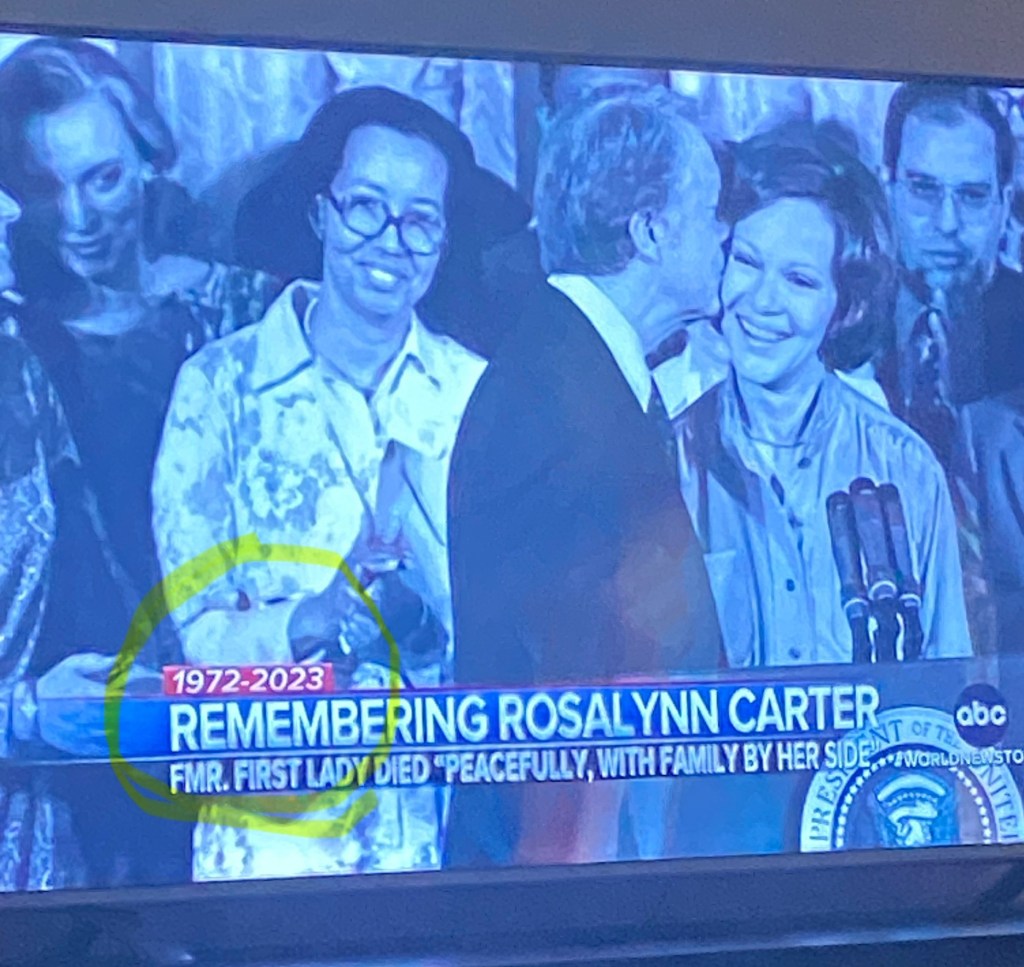
And the on-screen text accompanying news of the passing of Rosalynn Carter, who was 96 years old at the time of her death, demonstrates that haste can indeed make waste.

Sundry fun stuff

Things that come to my attention, via some online forums I follow.

  1. Thinking about the time I said I was distantly related to Marie Curie and a guy corrected me, saying, “I think you mean Mariah Carey.”
  2. Study finds that atheists are more likely to own cats and Christians. Is it legal to own a Christian?
  3. “Fun fact: the blending of idioms is called a malaphor, as in “We’ll burn that bridge when we get to it.”

Happy New Year, and let’s write carefully out there, people.

Joe Diorio is the author of “A Few Words About Words. A common-sense look at writing and grammar” (Beaufort Books, 2021) and “Murders at Trask: Crisis communications and the art of making nothing happen.” (Beaufort Books, May 2024).