Words Can Hurt

February Newsletter Art

By Joe Diorio

I have said in jest in this newsletter that words hurt. The reality is that words can do far worse than hurt. They can cause stress and more serious health situations. 

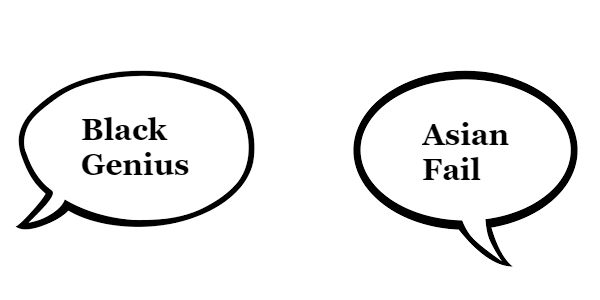
In a report paid for by the National Science Foundation, Vanderbilt University Professor Ebony O. McGee says terms like “Asian fail” and “Black genius” are neither a joke or a compliment. Her research shows they are derogatory and marginalize those who are the targets of such terminology.  

“Asian fail” is in the Urban Dictionary and is defined as to not get an “A” in a class. While “Black genius” is not in the Urban Dictionary it is frequently used to insinuate that an individual is bright beyond a stereotype. Both are psychologically detrimental, Prof. McGee says.  

“Racialized labels foster marginalization, which can have negative effects on the body and the mind,” argues Prof. McGee. “Both of these racial groups endure emotional distress because each respond with an unrelenting motivation to succeed that imposes significant costs.” 

Prof. McGee understands this from personal experience, having worked as an engineer before her time as a college professor. She said she was the target of comments about her gender and race that undermined her abilities. 

In the report, she encourages coalition-building among racial groups in order to build psychosocial coping skills, as well as other strategies for dealing with the effects of stereotypes and labeling. 

From the “Squad Squad” Files 

Last month the White House said the State of the Union speech should be delivered “on time and on schedule.” One late night host mined that for humor to say the two terms were redundant. Well, not exactly. 

Oxford defines on time as being “punctual” or “in good time.” A third definition offered is “on schedule,” which Oxford also defines as “on time, as planned or expected.” 

Our language is rife with homonyms (words with the same spelling and pronunciation, but have different meanings), homophones (words with the same pronunciation, but different spelling and meanings), and homographs (words spelled the same but have different pronunciations and meanings), so it isn’t surprising that there could be multiple combinations of words that mean either the same thing or slightly different things.  

It’s a close call – closer than this year’s Super Bowl, for sure – but I recall a lesson from more than one teacher who said one should go with the first definition in the dictionary. By that lesson, then, if you use the first definition of “on time” (punctual), it appears there is a slight difference between “on time” and “on schedule.” Penalty flag to the late-night comic in this case. 

Going without words – priceless 

In early January MasterCard said it would stop using the name “MasterCard” in its graphic designs and just go with the interlocking circles. The company’s reasoning is that the image of the circles is well-known – enough so that the text is redundant. Nike and Target have similar tactics in their marketing. Nonverbal communication is a learned form of communications, growing out of a society’s culture. Since MasterCard has been around for 52 years, the company probably figures it’s enough a part of the culture to get cozy with us.  

And lastly 

A recent presentation by my colleague Mike Deas, “The Art of Logic in Language,” pointed to disconnects we commit when communicating, such as two signs at a motor vehicle inspection station. The first one tells car drivers to turn off their radios, yet the second sign says, “For More Information Tune to 107.5 on your radio.” His presentation reminded me of one of my favorite pet peeves: the sign in a restaurant bathroom that reads, “Employees Must Wash Hands.” Trust me, I have stood in that damn bathroom and no employee shows up to wash my hands. (Think about that one.) 

Let’s write carefully out there, people. 

Joe Diorio is a writer living in Nashville, Tennessee. You should tell your friends and colleagues about him
It’s the celebration of Festivus. Let the airing of grievances begin.

january 2019 artwork2

By Joe Diorio

I avoid political discussions in this newsletter and won’t break that rule now. But since I reserve the January issue for my celebration of Festivus, the airing of grievances, I will point to a December 27, 2018 story in The New York Times explaining that the shutdown of the federal government boils down to one’s definition of the word “wall.” Concrete, steel, and a beaded curtain were offered up as examples. 

For whatever it’s worth, the dictionary defines “wall” as a continuous vertical brick or stone structure that encloses or divides an area of land. That seems to exclude beaded curtains, but I’m sure the debate will continue. 

Decorative border accoutrements aside, the past year provided many opportunities to lengthen the Festivus pole. Here are but a few: 

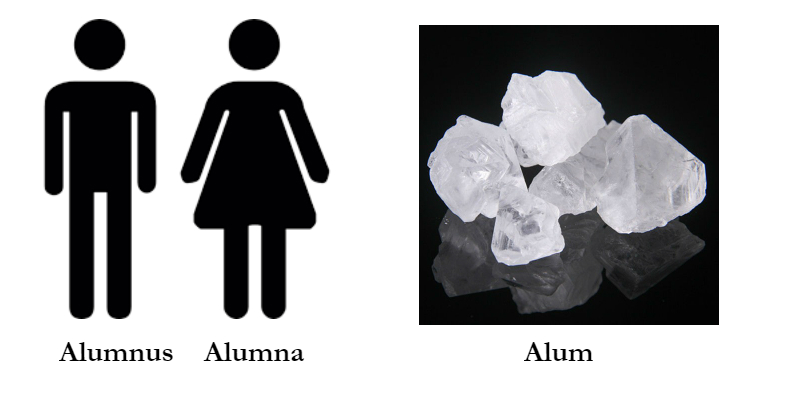
They are graduates, not a chemical. A dean at an institution of higher education where I worked (I worked for Vanderbilt University and the University of Pennsylvania. Let the guessing games begin.) frequently referred to a graduate as an “alum.” This person isn’t alone in making that mistake. The word “alum” is short for potassium aluminum oxide, a colorless astringent compound that is a hydrated double sulfate of aluminum and potassium, used in solution medicinally and in dyeing and tanning … and that is more than you probably ever want to know about alum. 

However, an “alumnus” is a male graduate. An “alumna” is a female graduate. “Alumni” is the plural for male and female graduates, while “alumnae” is the plural for female graduates. I just explain the rules. I don’t make them. 

By land or by sea. Sadly, 2018 had more than its share of occasions to lower the flag halfway. Here’s hoping we’ll need to do that less often in 2019. But if we do, remember that lowering the flag on a flagpole that’s in the ground is lowering it to “half-staff,” whereas lowering it on a boat is “half-mast.” 

Recognize that language is evolving. There are those – I was recently among them – who would argue that the pronoun “they” is plural. Yet the use of “they” as singular, especially for non-binary individuals, is largely accepted today. Language evolves and absorbs over time. Sometimes it takes a while, since Emily Dickinson was using “they” as singular over 100 years ago when she wrote “Almost anyone under the circumstances would have doubted if [the letter] were theirs, or indeed if they were …” Also, I rarely argue with Merriam-Webster.  

Stop relying on spellcheck. This is a good New Year’s resolution for everyone. A flyer for a New Holland, PA charity’s open house said, “Donations Excepted.” Spelled correctly, all right, but a bit confusing to the reader.  

Conversely, stop and look when that red line shows up under text. An on-screen graphic accompanying a TV news story about a big game between the Tennessee Titans and the Indianapolis Colts said post-game coverage would include “Players Reax.” The word “reax” appears in the Urban Dictionary as an alternative to “reaction.” Go slow with absorbing new words. Especially for those of us who are hipness-challenged. 

And a holiday kudos goes to I usually find cause to beat on the press for grammatical miscues, but on December 22, 2018 humor writer Ysabel Yates penned a wonderful op ed in The New York Times where she offered some critical edits to the song “Rudolph the Red-Nosed Reindeer.” Here’s a sample:  

“’You would even say it glows’ feels a little flat. Add a simile here, and make sure it’s consistent with [the] character. For example, ‘Glows like the end of every cigarette he swore would be his last.’”  

Happy New Year, and let’s write carefully out there, people. 

Joe Diorio is a writer living in Nashville, Tennessee. You should tell your friends and colleagues about him

Surviving a word tsunami

WordTsunami

By Joe Diorio

In 1985 IBM gave each of its 430,000 employees a business card-size document listing all the company holidays (New Year’s Day through to Christmas) for the coming year. This was pre-internet so there was no web page for that information. Everyone who worked for the company, therefore, could look at this card and see that one of the holidays for the upcoming year was Thanksgiving, which would be on THURDSAY, November 27.

Ow.

Typos happen to all of us. Sometimes they’re more prominent than others. “It’s you versus a tsunami of words,” a supervisor once told me. “Eventually, one that’s spelled wrong is going to get past you.”

We should all have such an understanding manager. Today there is texting, social media, and 24-hour news cycles so that tsunami of words is bigger than ever. We need a plan to proofread our writing. Here’s one systematic way to do that.

For starters, the moment you finish writing something put it aside. Time is your friend, even if a deadline is breathing down your neck. Play a round of solitaire on your smart phone. Anything other than looking at what you wrote. Sandie Giles, author of How to Proofread Your Own Writing, says impatience and familiarity are two factors that are detrimental to your ability to proofread. A bit of separation can help you catch that errant mistake.

Next, plan on reading your document at least four times, looking for specific things each time. Do not just say “I’ll carefully proofread it.” HOW will you do the proofreading? A plan spells out several reads you should do for your document and identifies what you will read and what you should look for.

First pass – misspellings. A colleague who worked for the Associated Press said he reads with the assumption that every word is misspelled. While you may not have to be that xtreme (See what I just did there?) focus exclusively on how each word is spelled.

Second pass – punctuation. Do you have the period or other punctuation inside or outside quote marks? (Hint: they go inside.) Is that semicolon necessary, or can you break the sentence in two? Quick mea culpa. I love using semicolons. It makes me think I’m smarter than I really am.

Third pass – formatting. A generation ago Strunk and White in The Elements of Style advised us to “choose a suitable design and hold to it.” Are any subheads you use formatted consistently? Is each paragraph indentation the same? In lists do you use bullets or numbers? And in those lists are you using parallel construction with an action verb to start each point (as in “build,” “wait,” “stop,” etc.)?

Fourth pass – have someone else read it. I have several friends and colleagues who proofread my monthly newsletter, A Few Words About Words, to be sure it’s right. And occasionally mistakes do get through.

Professional communicators put a lot of effort into their messages. How those messages are proofread is the final step to make our work successful.

Let’s write – and proofread – carefully out there, people.

(Joe Diorio is a freelance writer living in Nashville, Tennessee. You should tell your friends and colleagues about him.)

Join my mailing list. My monthly newsletter is free and I never sell lists.

No bullet points allowed

No bullet points allowedVeteran advice on the new world of speeches

By Joe Diorio

I worked for a time as a speechwriter for a pair of executives at IBM. One was a very good speaker. The other? Well, he was otherwise good at his job.

The good speaker rarely used slides and kept his talks to 20 minutes or less. The other? I once had to create a slide to explain a previous slide in one of his presentations. And he routinely needed at least 10 minutes just to introduce himself.

Point made. Public speaking is hard. And it is only getting harder in a social media world. Apple recently said it limits executives to ten minutes for a speech. And a wonderful presentation from Google doesn’t use a single bullet point. Clearly the rules of public speaking are changing.

Some speechwriters have sound advice on making good presentations in today’s social media world.

“I follow the ‘10/20/30’ rule. Ten slides to present in 20 minutes and nothing smaller than 30-point type on the slides,” says Thomas Mattia, a former executive who ran communications for Coca Cola, Yale University, Electronic Data Systems, and Ford Motor Company. “You have to make your points as convincing as possible in the shortest amount of time.” He teaches a storytelling class at Rutgers University and has students follow the 10/20/30 rule.

The message and good writing are the primary concerns for another veteran speechwriter. “A picture may be worth 1,000 words, but a picture of 1,000 words is worthless,” notes Boe Workman, director of CEO Communications for AARP. Workman is firm in his belief that the slide is not the speech.

Liz DeCastro, executive director of marketing communications and events for the National Council on Compensation Insurance (NCCI), says she has a team who works on developing images that support rather than repeat a speaker’s message.

“I once sat in on a presentation on a very technical subject,” DeCastro says. “The speaker used no notes, and the images supported – not repeated – what he said. I always try to take that approach myself.”

Workman said the length of a speech is secondary to the quality of writing. “I don’t buy that a 10-minute speech is hard to do,” he says. “People can’t listen to a five-minute speech if it’s not written well. If well written, then the audience will be mesmerized by it.”

Odds and ends

I tend to give broadcasters more than their share of mulligans, but I couldn’t let pass the bromance that networks and local affiliates alike have with using the word “facility” during reporting of the delivery of pipe bombs to high-profile Democratic party members and their supporters. “Mail facility,” “bomb disposal facility,” “investigation facility.” Gloriosky, folks, how about “post office,” “safe disposal site,” and “crime lab.” I figured the sports report would be all clear, but Nissan Stadium, home of the Tennessee Titans of the National Football League was referred to as a – you got it – “sports facility.”

Lastly, lest no one thinks I only pick on broadcasters, the New York Times, in a preview story about the World Series between the Boston Red Sox and the Los Angeles Dodgers, said “Beat! L!A! are the three most famous letters in Boston.” Really? What’s the third letter?

Let’s write carefully out there, people.

Dull writing = bad marketing

wordsalad

By Joe Diorio

Dull writing, in an age when we seem to spend less and less time looking at the written word, is the proverbial kiss of death for marketing communication professionals trying to carve out a niche for their companies or clients.

Almost a decade ago Nicholas Carr asked the question in The Atlantic magazine, “Is Google making us stupid?” He discussed the scan and graze nature of reading in the age of instant information. “[The] Net seems to be […] chipping away at my capacity for concentration and contemplation,” he wrote.

In the ensuing years social media seems to have done to prose what Google may have done to reading. The demand for quick and up-to-the-nanosecond communication is leaving good writing in its wake. A quick scan of my news feeds on Twitter and LinkedIn shows the text in each post possesses the same banal monotony.

  • “We are so proud …”
  • “Today I had the chance to …”
  • “This is super interesting …”
  • “Humbled by my introduction to …”
  • “Excited to announce …”

People, people, please stop! We can do better.

OK, so writing and grammar are ever evolving. Fans of William Safire’s “On Language” columns in the Sunday edition of The New York Times understand this. Also, there is a lot of pressure to produce content. Jayson DeMers writes in Forbes, “The growth of the internet means that everyone is publishing more content than ever […] the sheer volume of social media posts, articles, blog posts, images, videos, and more means that there’s that much more potential for error.”

Still, we need good writing when people spend less time reading. Is there a solution? Yep. “Omit needless words” advises The Elements of Style. Each of those introductory lines cited above can and should be axed. We know you’re proud, excited, and humbled. Tell us WHY you are that way.

Ted Sorensen, who I had the privilege of meeting in 2009, gives the same advice, but with more style than I can muster. (I’ll shorten his advice since we’re all reading this online.)

He said a salesman was setting up shop to sell seafood. First pass at a sign: “Fresh Seafood, Fish for Sale.” Well, the salesman thought, who would sell stale fish? He shortened the sign to “Seafood, Fish for Sale.” Heck, fish are seafood, so the word “fish” was dropped. But if I’m selling seafood in a store why say it’s for sale? The final sign outside his store read, simply, “Seafood.”

And, by the way, I’m confident he was proud, excited, and humbled by the chance to open his store.

Let’s write carefully out there, folks.

Joe Diorio is a writer living in Nashville, Tennessee. You should tell your friends and colleagues about him.

BONUS: Hootsuite offers a list of Twitter feeds exemplifying good writing.