My Blog

January is Festivus Time

By Joe Diorio

January 2024

I save the month of January to share grammatical rants from myself and readers of this newsletter. Here are a few:

The Washington Post on December 26 reported that the Miami Dolphins for the National Football League “grinded out” a victory with a 22 – 20 win over the Dallas Cowboys. I am not the most ardent NFL fan (Although I do follow the New York Giants, who I affectionately say are in year 12 of a five-year rebuilding plan.) but my ear tells me perhaps the Dolphins “ground out” a victory.

Welp, it seems my ear is correct. To use my professor-sounding voice, “grind” is an irregular verb, meaning it does not follow accepted and delineated conjugation rules. The past tense of “grind” is actually “ground.”  So, the Dolphins ground out a victory. If you think about it, you would not say “I grinded some coffee to brew.”

Pack my what?

I can only speak for myself, but it grinds on my nerves when I hear a news report about crowds at airports and the reporter tells viewers to “pack their patience.” It isn’t how people normally talk. In fact, “pack your patience” isn’t even an accepted idiom in the English language. (Honest. I checked.) Take a deep dive into the statement and you quickly realize it doesn’t even make sense. An idiom is a statement of the exact meaning of the word. If you pack something you cannot easily access it, so why pack patience if you are going to need it while waiting in a TSA line? Free advice to news writers; “be patient” works better than “pack your patience.”

News crawls. The bane of TV news

The news crawl – the running text of headlines appearing at the bottom of the TV screen – at ABC News on Christmas morning suggested everyone, including the news crawl editor, had the day off. See the photo below.

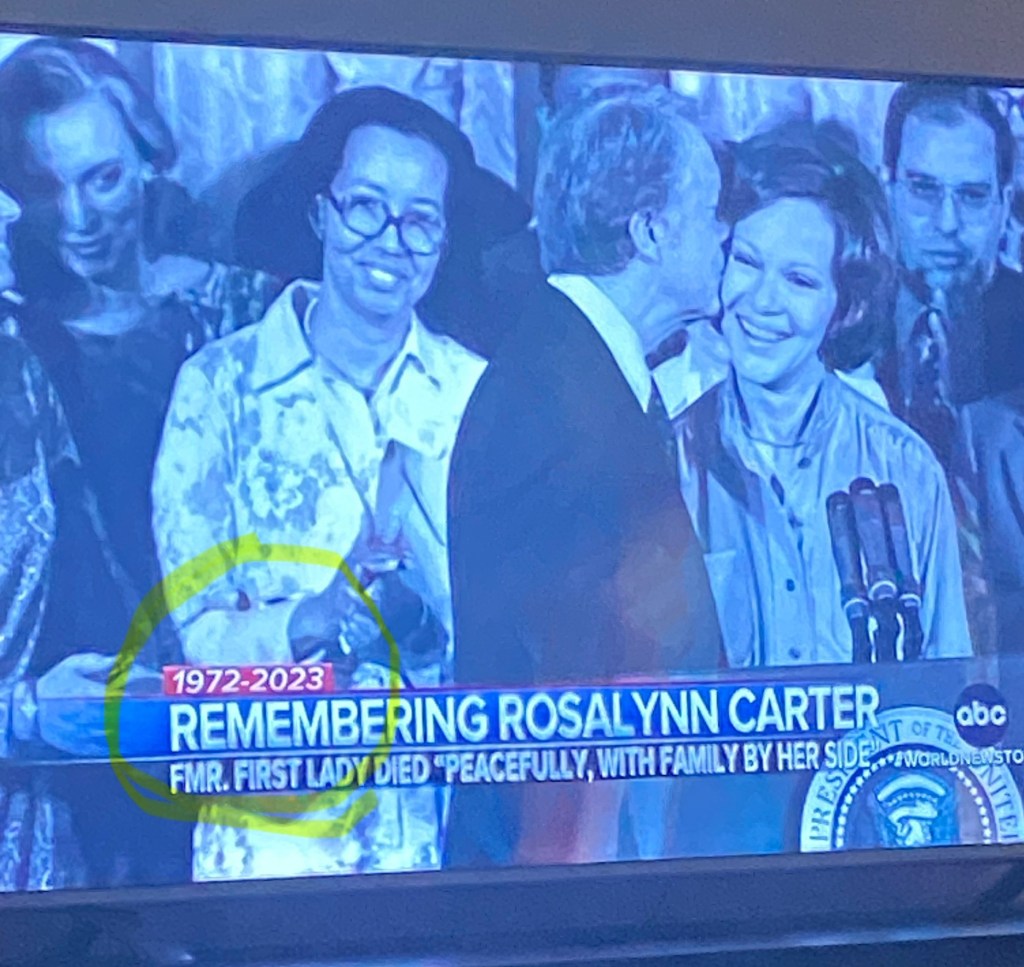
And the on-screen text accompanying news of the passing of Rosalynn Carter, who was 96 years old at the time of her death, demonstrates that haste can indeed make waste.
Sundry fun stuff

Things that come to my attention, via some online forums I follow.

  1. Thinking about the time I said I was distantly related to Marie Curie and a guy corrected me, saying, “I think you mean Mariah Carey.”
  2. Study finds that atheists are more likely to own cats and Christians. Is it legal to own a Christian?
  3. “Fun fact: the blending of idioms is called a malaphor, as in “We’ll burn that bridge when we get to it.”

Happy New Year, and let’s write carefully out there, people.

Joe Diorio is the author of “A Few Words About Words. A common-sense look at writing and grammar” (Beaufort Books, 2021) and “Murders at Trask: Crisis communications and the art of making nothing happen.” (Beaufort Books, May 2024).
Grammar matters, even when cursing

By Joe Diorio

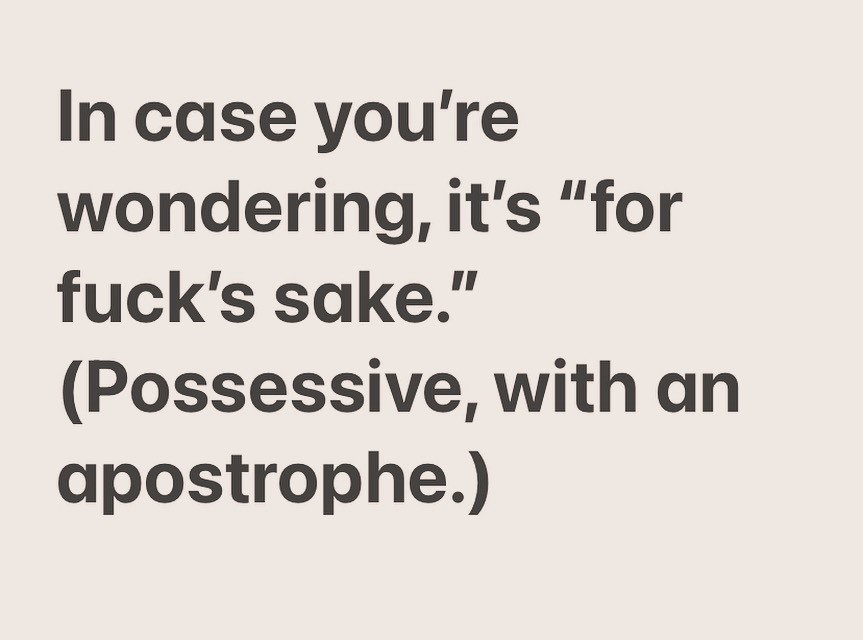
It’s “for fuck’s sake.”

Possessive. Use an apostrophe.

Honest.

The term is an expression of exasperation; the author is so tired of the situation that they throw their hands up and declare they are fed up with whatever the status quo is, as in “stop playing the music so loud, for fuck’s sake.”

I should also note that MS Word puts a blue highlight under the word “fuck” when it is used as the singular, indicating two things: there is a grammatical mistake there, and even the gang at Microsoft know a miscue when one is made.

Also, for whatever it is worth, the old idiom “for Pete’s sake” uses the possessive of Pete. Oh, and by the way, most lexicographers figure Pete is not a real individual. Instead, the use of the name is an outgrowth of the much older phrase, “for pity’s sake,” which dates back to the 17th century.

A Public Service Announcement

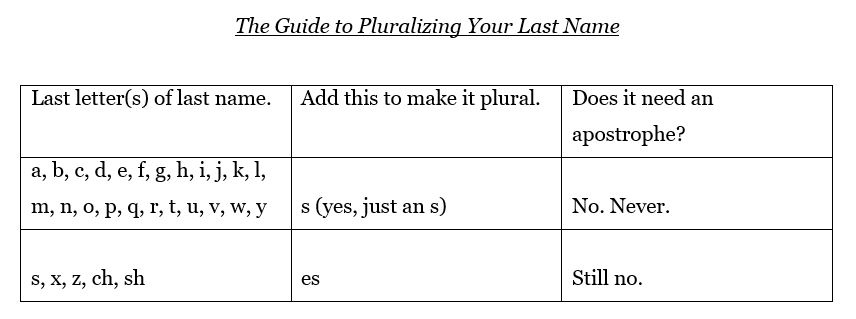
We are entering the time of year when greeting cards will show up in the mail. Here’s a handy graphic showing how to pluralize your name when you are writing greeting cards.

Delicate Reporting

A truck owner in Southwest Florida decided to use paint and decals on his truck to make it appear to be a Lee County, Florida sheriff’s office vehicle. But this truck had the words “booty patrol” on the side, rather than “sheriff.” Illegal? Questionable, but CBS affiliate reporter Michael Hudak and writer Rachel Murphy were able to insert a handful* of booty related turns of phrase into this two minute, twenty-second-long story.

*  Let’s keep our minds out of the gutter, people.

Let’s write carefully out there, people.

Joe Diorio is a writer, living in Southwest Florida. He is the author of A Few Words About Words. A common-sense look at writing and grammar (Beaufort Books, 2021) and the forthcoming Murders at Trask: Crisis communications and the art of making nothing happen (Beaufort Books, 2024).

Flush or Flesh Out?

By Joe Diorio

The Tennessee state legislature met recently to discuss measures related to gun safety. Tennessee was ground zero for a horrific mass shooting at a private school earlier this year, and emotions in the statehouse were a bit raw.

Very little was accomplished during the ten-day session, but a local reporter Tweeted (X’ed? I can never tell), paraphrasing Tennessee Lieutenant Governor Randy McNally indicating that more would be done on gun safety in January during the legislature’s regular session, “when they have more time to flush out [the] issues.”

Welp, to “flush out” means to remove something, whereas to “flesh out” means to build up or add to. I am not sure which meaning the reporter or Lt. Governor McNally wanted to use but considering that most Republican lawmakers (and Tennessee’s state house is overwhelmingly Republican) react to laws about guns the same way Superman reacts to kryptonite, then they may have meant “flush out.”

Stormfront writing

Colleague and friend Jeff Butera, author of Write Like You Talk. A Guide to Broadcast News Writing, offered a few helpful tips for anyone writing about hurricanes. And considering we’re in the midst of hurricane season, I suspect more than a few of us are writing about hurricanes.

Among his advice is to avoid subjective, dramatic, or sensational adjectives. Eleven years after Tropical Storm Sandy hit the U.S. East Coast it is still referred to as “Superstorm Sandy.” So unnecessary adjectives can take on a life of their own.

A new word is slowly entering the lexicon

As I have said before, words become words when they are used often enough to be considered part of our language. Some terms, like, “covfefe,” which came up in the early days of the Trump administration, come and go. Others have more staying power.

We may be witnessing a word – “Barbenheimer” – that may well enter the dictionary. Barbenheimer is a portmanteau for “Barbie” and “Oppenheimer,” and it is becoming shorthand for polar opposites. It sprouted from the popularity of the two movies, which themselves are polar opposites. Just recently, the public release of the mugshot of former President Trump and the availability of pumpkin spice lattes on the same day was described as a “Barbenheimer” moment.

Now lexicographers take their time before opening the pages of the dictionary to new words, but this one has a shot at Merriam Webster immortality. And you can say you knew it when. 

Speaking of new words, Dictionary.com just announced that several words were officially words, including “Jawn,” which is a Delaware Valley term used when the speaker does not know or need an official term. Now you know.    

Young journalists and faith in the Fourth Estate

Three years ago, the editors of the Daily Tar Heel at the University of North Carolina described the stop-and-go attempts at reopening the UNC campus during the COVID-19 pandemic as a “clusterfuck.” The profound use of profanity – in a headline, no less – may not have been appreciated by everyone, but it got the point across.

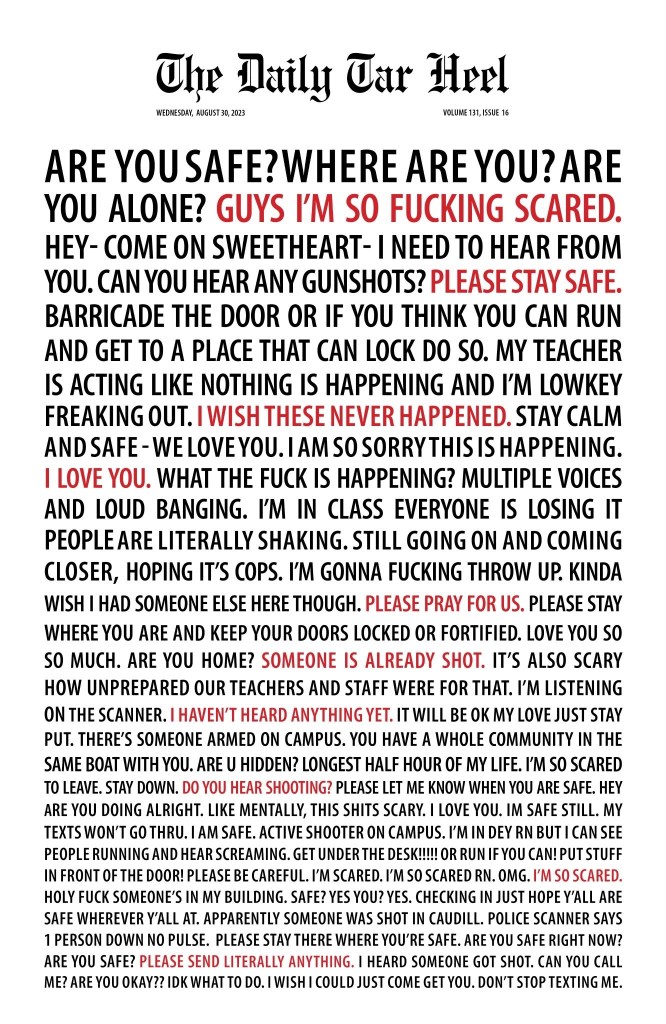
Late last month when a shooting at the UNC campus resulted in the death of a faculty member and sent scores of students into hiding, the Daily Tar Heel used the visual impact of multiple text messages to deliver the message that things are not normal in a world where shootings occur on a regular basis.

It demonstrates the power of words and restores my hope for journalism’s bright future.

Let’s write carefully out there, people.

Joe Diorio’s first book, A Few Words About Words, is available now. His next book, Murders at Trask: Crisis communications and the art of making nothing happen is forthcoming.

One Word

By Joe Diorio

A single word – don’t versus stopped, responsibility versus control, and the absence of the preposition at – can make all the difference in a message.

Don’t not stopped. Five years ago, I decided to stop drinking alcohol. No, I didn’t have a substance abuse problem. I just decided it would be better for my overall health if I didn’t drink alcohol.

Nowadays, if I’m at a social event and someone asks me if I’d like to have a drink I say, “no thank you,” then I am mindful to add, “I don’t drink.” I specifically do not say that I stopped drinking.

Saying “don’t” indicates just that. I don’t drink. But saying “stopped,” sometimes gives people the impression that alcohol for me was a problem. I know this because I have used the word “stopped” and someone asked me if I am in a twelve step program.

Responsibility, not control. Just recently, during an interview with ABC News, actor Matthew McConaughey was discussing his efforts to curb gun violence. McConaughey, a native Texan, is from the town of Uvalde, which was ground zero for a horrific mass shooting at an elementary school just last year.

McConaughey said he is for the idea of gun “responsibility.” He specifically did not say gun control. “No one wants to be controlled,” he said. “But responsibility is still something we can all go, ‘Yeah, I’ll take responsibility.’”

The absence of the word “at.” Television station WPVI in Philadelphia caught some flack recently when reporters referred to activities along the New Jersey shoreline as happenings “down at the shore.”

Now, “down at the shore” is perfectly acceptable grammar. But a piece of Delaware Valley dialect refers to the New Jersey beaches by saying “down the shore” and omitting the preposition “at.” A colleague in TV news used to record a travelogue segment she called “Down the Shore.”

Philadelphians who watch WPVI are not amused by this adherence to proper grammar, writing to the TV station questioning why the anchors don’t speak – well – don’t speak Delaware Valley. In its defense, WPVI points out that saying “down at the shore” is grammatically correct.

For the most part, Philadelphians reaction to this defense was “fuggetaboutit.”

Sometimes it all comes down to a single word. Let’s write carefully out there people.

Perfectly Cromulent

By Joe Diorio

Local television news often provides great content for this blog. Just recently a local network affiliate aired a story about a new police training center and referred to the building as a “facility” no less than seven times in a two-and-one-half minute long story. And to reiterate, “facility” is my least favorite word; it’s a sign of lazy writing.

But local television also is a great source for inspired prose, especially when Taylor Swift is in town for a concert. You need to calm down, shake it off, and breathe (see what I did there?) and tip the collective hat to Chris Long, a sports anchor for KSTP-5 in Minnesota. When Taylor Swift’s Eras tour arrived in Minneapolis, Long used his television broadcast voice to deliver his sports report, weaving in the title of 47 Swift songs in his report. That’s above and beyond in the creativity department. You can click here to see Long’s report.

Don’t talk like you’d write (and don’t write that way, either).

One of my favorite episodes of “The Simpsons” shows Mrs. Krabappel, Springfield’s fourth grade teacher, questioning whether “embiggen” is really a word (I checked the dictionary – it is. First recorded use was in 1998, meaning it may well have come from “The Simpsons” TV show.) and Miss Hoover, Springfield’s third grade teacher, tells Mrs. Krabappel that embiggen “is a perfectly cromulent word.” (And one of my proofreaders said she once heard Frank Zappa use “cromulent.” So there.)

Sometimes we trip on words as we are trying to sound smart. That may explain the language used by Joe Cronin, general manager for the Portland Trail Blazers of the National Basketball Association. Cronin described a recent meeting he had with player Damian Lillard as a “good dialogue.”

OK, I get it. Saying “good dialogue” is an acceptable substitute for “good conversation.” Both “dialogue” and “conversation” are nouns, and each word shows up in the dictionary definition of the other. Still, we should watch out for that deep desire we all have for fancy talk, no matter how cromulent the words are.

Almost 50 years ago television journalist Edwin Newman, in his book, A Civil Tongue, lamented the use of overly flowery talk, citing a Kansas City, Missouri meteorologist who said, “the heavy storm system that performed over our area last night.” (“Music by Rossini?” Newman asked.) More recently, Jeff Butera, a television journalist in Southwest Florida, author of Write Like You Talk: A Guide To Broadcast News Writing, urged writers to avoid what he calls “journalese” when they write. Both men offer everyone a good dialogue on how to embiggen their writing. (OK, I’ll stop.)

I wrote this, RIGHT?

Just as my skin crawls when I hear the word “facility” overused, communications consultant and media interview trainer Julie Parker feels the same way about the word “right” being used at the end of a sentence.

“It’s still happening. The question dropped at the end of a sentence that’s not really meant to be a question. ‘Right?’ is everywhere. On podcasts. On TV. On Peloton. It can distract your audience, or worse, annoy them. Gently tell people they’re using it. Help eliminate it,” she writes on her Twitter feed. She calls the use of “right” at the end of a sentence a verbal crutch that just isn’t necessary, adding that it “can muddy your message.”

Revenge spending is making a comeback.

On June 13 The New York Times reported that the travel industry is witnessing a significant increase in “revenge spending,” money spent to travel because we were cooped up at home for several years during the pandemic.

According to Google n-gram, revenge spending first showed up in our lexicon in the 1980s. It peaked around 1993 and slowly started to vanish by 2003. But it’s back as are so many delayed vacations.

Let me know if you heard this one.

I’m curious about the term “Pinned Tweet,” referring to a tweet one can have permanently show up at the very beginning of their own Twitter feed. I’m using it in my next book and wonder if it is familiar to readers. Let me know. (Yes, there is a next book on the horizon. This one is about crisis communications. You have been warned.)

Let’s write carefully out there, people.

Joe Diorio’s first book, A Few Words About Words, is available now. His next book, Murders at Trask: Crisis communications and the art of making nothing happen is forthcoming.