My Blog

Claw back that debt

By Joe Diorio

The phrase “clawing back” hit my radar during the recent negotiations over raising the federal debt ceiling. It was used to explain how the government would reclaim unspent COVID-19 relief funds.

The term claw back is defined as a strenuous or forceful action (Merriam-Webster) or a violent tearing action (freedictionary.com). In this case it conjures images of a federal bureaucrat – probably a GS-7 or lower – forcefully wresting money from the hands of some freshly identified ne’er do well. Was that an accurate explanation?

I canvassed a few folks in the news business to see if I have just been out of touch with newer terminology. A few had heard of it, but most had not. One reporter said she saw it used during the Bernie Madoff trial in the early 2000s; it referred to efforts to reclaim the millions of dollars investors lost by working with Madoff.

Google ngram, an online search engine that charts the frequencies of any set of search strings using a yearly count of ngrams found in printed sources published between 1500 and today, shows the phrase really took off in the early 2000s. Also, if you recall (or check Google) most of the money Madoff absconded with was never recovered, so clawing back in that case was not successful. Why, then, use a phrase that refers to an eventual fruitless effort?

This will sound off-topic but, trust me, it isn’t. Monkfish is the commercial name given to Lophius Americanus fish. It’s more appetizing sounding than “Fishing Frog,” or “Sea Devil,” which are other names for Monkfish. Perhaps saying you will claw back COVID funds sounds like Uncle Sam is doing his part to be mindful of taxpayer money. In other words, it’s a good P.R. term that grew out of a committee.

Punctuation is important

Does this mean you CAN or SHOULDN’T swim there?

If the photo isn’t proof enough that punctuation matters, then consider a recent email from U.S. Rep. Byron Donalds (R-Fla.) who on May 22 was touting laws he created, including, the Protect Our Law Enforcement with Immigration Control and Enforcement (POLICE, as it is called in the email … see what he did there?) Act, “to make the assault of a law enforcement officer by an alien, a deportable offense.”

Not sure if alien includes E.T. or that thing that bursts out of human chests, but the comma after “alien” seems as unnecessary as the acronym.

Throwing rocks with a knife

On May 20 an NBC affiliate in Fort Myers reported the arrest of a man for “throwing rocks at a window with a knife.” Drop me an email if you know how to throw a rock with a knife.

I was _____ years old when …
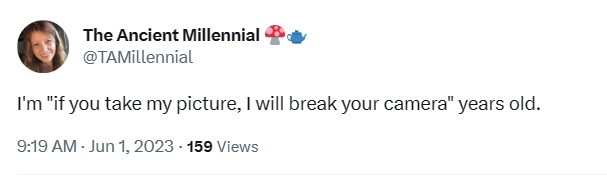
I heard the local meteorologist use this term recently, and it triggered the “where’d that come from” bone in my head. It’s an increasingly popular idiom, referring to some seemingly common piece of information that one has just learned. Its first appearance was in 2015 when a Twitter user talked about learning she was wearing the wrong size bra.

Google ngram is not tracking the use of the phrase (yet). Let me know if you have seen an increase in its usage.

It’s spelling bee time!

… and I am a horrible speller, but I do enjoy me a good story about offbeat words, like the one The New York Times ran on May 26 about words that have been in the Scripps Spelling Bee. Enjoy!

Let’s write (and that includes spelling) carefully out there, people.
A RUD of Space Jargon

(Read on. It’ll make sense.)

By Joe Diorio

On April 20 SpaceX launched its heralded “Starship” rocket on an unmanned test flight. The 400-foot-tall rocket and booster is designed to eventually take humans to Mars. 

The blastoff was impressive, but about three minutes into the flight the giant spacecraft started doing 360-degree spins. The anticipated separation of the Starship itself from the Super Heavy booster, which is powered by 32 individual Raptor engines, didn’t occur.

(By the way, other than warp engine, Raptor is about the coolest name there is for a spacecraft engine. Fight me on this one.)

They weren’t in Houston, but they had a problem. So, they did what any space flight operation would do when the spacecraft encounters some bad juju; somebody punched the self-destruct button making Starship and the Super Heavy booster explode. They called this maneuver a “Rapid Unscheduled Disassembly” or RUD.

Twitter had a field day with that term.

“We’re pretty good with synonyms, but rapid unscheduled disassembly is a new one, even for us,” tweeted @Dictionarycom.

“Rapid unscheduled disassembly has to be one of the funniest ways of saying, ‘shit, our rocket blew up,’ said @H_MitchellPhoto.

Rapid unscheduled disassembly is such a friendly way of saying, ‘it blew up, but we learned a lot on the way,” said @MKBHD.

“Have decided my tanks have not been getting destroyed. Instead, they have ‘rapid unscheduled disassembly, said @DarthPutinKGB (obviously – hopefully? – a parody Twitter account.)

My favorite? “I do not destroy my toys. They simply experience a rapid unscheduled disassembly. This has nothing to do with me,” wrote @dog_feelings.

SpaceX went back to the drawing board. Twitter writers will be waiting, I’m sure.

Writing Lesson for All

Last month I put a writing assignment in this newsletter, asking readers to describe the following as though you are an angry motorcycle cop: Opening the windows and letting in fresh air. I received some impressive entries:

From Jerry Lademan, a semi-retired broadcast journalist from Upstate New York: “The veteran cop was increasingly annoyed at the stuffy air in the cramped room at the back of the precinct office, and the long wait for the disciplinary board’s return only made him more ornery than usual. The office had only one antiquated window that was probably an original from the building that was soon to be replaced with a shiny, new department HQ across town. Screw this, he grumbled under his breath as he got up from the hard wooden chair and went to the window. He put his stubby fingers into the casement opening and heaved upward. The window, which probably hadn’t been opened since he was a rookie in the 1980’s remained stubbornly shut. Another thrust. The balky frame again creaked and groaned but barely budged. His anger at the window brought back memories of the anger he felt the day of the fateful traffic pursuit. With a final, mighty push the window gave, but as it did the inside pane shattered. The sound of the cracking glass was joined by another sound—of the oak door announcing the arrival of the top brass who would decide his fate.”

From Tim Fallis, Ph.D., an advisor to Par Hawaii Refining: “Eyes smoldering with contempt behind oversized aviators, inhaling bitterness and exhaling rage, she cranked the jalousie as if it were an AMC Harley she loved and hated in equal measure.”

But my favorite came from a former coworker at Ketchum Communications, Doug Rose, who asked ChatGPT to do the work:

“What the hell do you think you’re doing, huh? Cracking open those windows like you own the damn road? You think just because you’re behind the wheel, you get to decide when and where to let in fresh air? Well, think again, buddy! You’re not the only one on the road, and your actions affect everyone around you. You wanna let in some fresh air? Fine, do it when you’re parked on the side of the road, not while you’re driving and endangering others. So roll up those damn windows and focus on the task at hand, driving safely and responsibly. Got it?”

I’m still accepting submissions. Show me what you can do!

Lesson learned

A few years ago, a reader rightfully chastised me for improperly writing “less” when I should have said “lest.” From that day forward I use two or three proofreaders on each issue of AFWAW, lest I screw up again.

That lesson came in handy on April 19 when the daily crossword puzzle clue for 71-across was, “For fear that.” Four letters. The answer, as I learned way back when, was “L-E-S-T.”

Let’s write carefully out there, people.

Spring Training

Making Grammar Cool Again

By Joe Diorio

Everyone can use a workout to stay in shape. (That’s probably the lamest opening line I have ever done, but I’m sticking with it.) So here are a few exercises to tone up our writing.

Proofreading tip. For me, proofreading is the toughest part of writing. “I’ve already written this,” my brain tells me. “There are no mistakes.” Of course, it’s right after I hit “send” on that email when I realize I really wanted to write “duck.”

That said, here is a nearly foolproof proofreading technique:

  1. When you finish what you are writing, stop and play a game of solitaire on your phone. It doesn’t have to be solitaire. Just do something other than look at what you wrote.
  2. Next, return to the document and change the font. Sans serif to serif or vice-versa, doesn’t matter.
  3. Then proofread the document.

This simple procedure works wonders. Changing the font will trick your brain into thinking you are reading a brand-new document and you will inevitably catch mistakes you might not catch otherwise.

Shaking the cobwebs loose. Part I. Regardless* if you are writing a business press release or a passage for your great American novel, we all need to shake our creative juices.

Describe this as though you are an angry motorcycle cop: Opening the windows and letting in fresh air.

Stop laughing. It’s an exercise to stretch your creative juices and NOBODY has to see what you wrote. I have used the Ernest Hemingway quote about first drafts far too often, but just trying an exercise like this works. Try it. Here’s my attempt:

Wasting little time, he ripped the double-hung open like it was an offensive lineman in his way.

Send me yours!

Shaking the cobwebs loose. Part II. If you’re stuck, try changing one aspect of your draft. Writing a scene for a novel? Change the weather. Writing about a new gadget the Trask Company will roll out to the market? In your draft (and I can’t stress this enough – in your DRAFT, not anything you send around for review) write about the new gadget’s global killing effects. Writing about something that is completely off-topic will help you generate fresh perspectives.  

The “est”?

After defeating the Villanova University women’s basketball team to move into the “Elite Eight” of the NCAA Women’s Basketball Championship tournament, University of Miami Coach Katie Meier told reporters, “there is no ‘est’ here. We’re just looking toward the next game.”

Meier’s use of the term “est” is a crazy-shortened version of the word “best.” It’s colloquialism for sure, but it’s one that I admit I hope doesn’t catch on. After all, take away ‘est’ from ‘best’ and you are left with ‘b’ and methinks a shortened word should have enough left to have the original meaning attached to it.

The practice of shortening a word to an idiom isn’t new. Fifteen years ago when the Philadelphia Phillies were winning Major League Baseball championships every year, a popular T-shirt sported the word “ill,” stylized with the same font used in the word “Phillies” uniforms. 

Book News

Mark your calendars for May 2024 (or thereabouts). That’s when my second book, Murders at Trask. Crisis communications and the art of making nothing happen will be published. It is a look at crisis communication planning and is loosely based on a mass shooting event that I, sadly, was in the middle of 40 years ago.

I shall be relentlessly promoting, asking for early reviews, etc. You have been warned.

Let’s write carefully out there, people.

* Yes, I used regardless, not irregardless. (But both are words. Honest.)

The downside of technology

By Joe Diorio

My former employer, Vanderbilt University’s Peabody College of Education and human development (Yes, lowercase “human development.” I forget why that is and – admit it – you don’t give a fig, either.) became embroiled in a ChatGPT debate when a letter about a mass shooting at Michigan State University, a letter written by the AI system but holding a byline of two faculty members, was sent to Vanderbilt students. The authors neglected to remove the last few lines of the letter where there was an acknowledgement that it was the AI system that did the writing.

The “how dare they” outrage over the idea that an impersonal AI tool was used to write about a human tragedy led to the two faculty members stepping down from their assistant dean responsibilities, and Peabody College Dean Camilla Benbow promising a full “how’d this happen?” investigation.

I like my colleagues at Peabody and feel sorry they were in the middle of this brouhaha. But the story for me says a lot about how ChatGPT fits in with our writing toolboxes.

More than once I have been asked, “Hey, you’re a writer. Whaddya think of ChatGPT?” The truth is, I don’t think about it much at all. ChatGPT is a tool. Just like spell check. Just like Grammarly. These tools have their good and bad points.

I still maintain that spell check systems make us bad spellers, because we let the system do the thinking for us. Grammarly can do that, too. (“Affect or effect? Ah, let Grammarly figure it out.” Yes, someone once said that to me.) Sadly, the folks at Peabody had a similar lesson when they let ChatGPT do the thinking. 

If you want to let ChatGPT write something for you, then go for it. But what it spits out should be treated as a first draft. And remember the admonition from Ernest Hemingway, “The first draft of anything is shit.”

Enough said.

“The French?” “The homeless?”

The Associated Press took literal aim at its foot recently, when in a tweet it suggested writers avoid use of the word “the” when speaking about groups. That is, say, “French” rather than “the French.” Or say “homeless” rather than “the homeless.” AP (not “the AP,” I guess) says use of “the” can be dehumanizing. Eventually the AP modified its position, apologizing if its advice was an inappropriate reference to anyone.

Nicholas Kristof used this as an example of how language wars continue, noting arguments over “homeless” versus “people without houses,” or saying “birthing people” versus “women.” Kristof’s op ed takes a look at language in its role in culture wars. It’s a good read.

Word of the moment

Kudos to Mike Tannenbaum, former general manager of the New York Jets and current football analyst for ESPN. On a February 21 episode of the morning sports talk show Get Up Tannenbaum used the word “prolificity,” generating a wave of playful ribbing from his TV coworkers and causing one newsletter editor to turn to the dictionary. Well, prolificity is a noun, referring to power or character, and Tannenbaum was talking about the power and influence some NFL players can have. Well played, Mike T.

Subject/noun agreement anyone?

I heard the following in a local TV news story, “A bullet was found in a driveway the size of a quarter.” All I can say is, man that is one small driveway. Let’s write carefully out there, people.

Come on, man!

By Joe Diorio

I resist picking on grammatical errors committed by anyone in the news business. I worked in that field, and I know whatever is written – be it for print or broadcast – is often done at the eleventh hour, a term that is defined as something being done at the latest possible moment before it is too late. That’s a ripe environment for making mistakes.

Despite this reluctance, a few grammatical miscues by print and broadcast news outlets landed in my in-box and I’m feeling the need to share.

From NBC4 in Washington, D.C., on January 20: “The family of a D.C. teacher who died in police custody is suing Los Angeles police for $50 million, and placing bets at FedEx Field.” Welp, they probably had a good financial settlement. But I thought placing bets at National Football League venues, which is what FedEx Field is, was illegal. Oh, well.

From a daily briefing email by The (Fort Myers, Florida) News-Press: “Gov. Ron DeSantis pushing for permanent ban on COVID-19.” So, all it took was a ban?

From a local ABC affiliate on January 6, reporting that the pier in Naples, Florida was severely damaged during a hurricane. “Two-hundred feet of the pier are missing,” said the reporter covering the story. The use of the word “are” in this case rubbed my eardrums the wrong way. The pier is one thing, and it is a specific number of feet in length, just as I am a specific number of feet and inches in height. Sadly, because of severe back problems I am no longer as tall as I once was, but I don’t say, “an inch and a half of me are missing.” Similarly, because of the hurricane, one should say 200 feet of the pier IS missing. Fight me.

And just to show I am not the only editor whose hackles get up in a ruffle over language, @juliaproofreader on Twitter offered the following advice (admonition?) on January 23:

“Magazine fashion editors! Please don’t use the ghastly hackneyed phrases:

  • ‘Opt for’ – IRL, nobody ‘opts for’ anything.
  • ‘Team’ i.e. ‘teaming’ one item of clothing with another.
  • ‘Toasty’ – absolute worst offender, to describe the condition of keeping/making one warm. (imagine a puke emoji right here).

Cheese-it, the grammar police!

Last month’s note about forming the plural of the snack Cheez-Its by saying “Cheez-It Crackers” rather than “Cheez-Its,” prompted a question from one reader, “Does anyone say ‘Cheese it, the cops’ anymore? Or is it confined to old movies aired by TCM (Turner Classic Movies).”

Saying “Cheese it, the cops” was used as a clarion call by the bad guys to run away because the police are closing in on whatever nefarious activities they are up to. Saying “Cheese it” may be a corruption of “cease,” as in “stop what we’re doing,” but according to thefreedictionary.com the exact etymology isn’t known. BTW, anyone notice I just used “nefarious,” “clarion call,” and “etymology” all in one paragraph? I’m loving this passage, people.

Drop me a note if you use the term or hear it used in everyday conversations.

Will somebody please fix that drip?

The discovery of government classified documents at Mar-A-Largo, Joe Biden’s house in Delaware, Mike Pence’s house in Indiana – has anyone checked Oprah’s house? Just asking. – brought about the ear-rattling term “drip-drip-drip” in news stories. It is news jargon at its worst, referring to bite-size pieces of news about a story becoming public very slowly. The use of the term was pervasive enough for a video skit on The Late Show with Stephen Colbert on January 23.

I first encountered the term in the mid-1970s when the Presidential Administration of Richard M. Nixon was embroiled in a cover-up pertaining to a break in at the Democratic National Committee headquarters in the Watergate Hotel. The question dripping away at the news then was, “what did the President know and when did he know it?” I’m just wondering if anyone has counted how many times the term “drip-drip-drip” has been used?

Let’s write carefully out there, people.