My Blog

It’s Festivus! Come to the keyboard to complain.

By Joe Diorio

The New Year (yes, it is capitalized) marks time for the grammatical celebration of Festivus, where we gather around the keyboard and share our pet peeves.

Sometimes I wonder if there will be enough content for a good Festivus edition. Then the internet smiles upon me and “irregardless” trends on Twitter. Yep, nearly 3,000 tweets in a single day on Thursday, December 15.

“Irregardless is not a word. Just use regardless. Thank you for listening to my TED talk,” writes @RandomIgnorance.

“Irregardless, I hate it when someone writes “loose” but means “lose” says @PericaErica.

“As irregardless is trending, may I also take this opportunity to remind you that the correct phrase is COULDN’T care less. To say, ‘I could care less’ implies that you ACTUALLY F___ING CARE,” say@DDRey.

“Many people find irregardless to be a nonsensical word, as the ir- prefix usually functions to indicates negation; however, in this case it appears to function as an intensifier,” writes @JAMESEDSTROM

I have discussed this before, but once more (with feeling) … irregardless is a word. It has been a part of our language for over 200 years. Merriam-Webster defines irregardless as “nonstandard” meaning same as “regardless.” It also advises us to use “regardless” instead.

Now let me duck before you start throwing blunt objects around.

From the “Aw, you know what I mean” department

Item #1: Writing to a colleague at Northampton Community College in Pennsylvania, Jon Jay DeTemple, president of Harcum College in Bryn Mawr, Pennsylvania (mea culpa, I used to work there) asks, “Could we get away from using the term “school?” [M]ost do say ‘college.’ For years we have fought the perception that we are just an extension of high school. Let’s upgrade and use the generic ‘college’ in our communications.”

DeTemple’s desire for us to view Harcum as an institution of higher education is a struggle community colleges and junior colleges sometimes face. The effort exists inside and outside the college. A coworker at Harcum once said to me, “What’s the difference between senior year in high school and first year of college? Two months.”

For anyone who is wondering, a college represents a field of study – a college of liberal arts, or engineering, or law, etc. whereas a university is a collection of colleges. Now you know.

Item #2: The phrase, “I’ll print that out for you” is my personal fingernails on a chalkboard. A “printout” is a noun, referring to something that just came out of a printer. If you are sending something to a printer, then you are simply printing it.

Item #3: Honoring Franco Harris. “What’s ESPN thinking?” wrote one reader in late December. “They said they are ‘honoring’ the death of Franco Harris! Are they happy he’s gone?”

The writer of that email is referring to the former running back for the Pittsburgh Steelers of the National Football League, who died suddenly at the age of 72. The ESPN utterance the writer took umbrage to was, “We honor the death of former Steeler Franco Harris.”

Use of the word “honor” as a verb in this case is probably something we all do. It means “regard with great respect.” If someone is being picky, like the person who wrote to me, then saying you “honor his death” means you are showing respect to the fact that someone has died, which is probably not what you mean. A more accurate sentence would by that you honor the career of the late Franco Harris.

Nothing will cheese you off like pluralization

Irregardless isn’t the only term lighting the internet on fire. As the University of Oklahoma and Florida State University prepared to square off in the Cheez-It Bowl on December 29, the company that makes the salty, cheesy snack shook the Twitter tree when it said the plural of Cheez-It is NOT Cheez-Its, but rather “Cheez-It crackers.”

Fans were, not surprisingly, cheesed off.

“Everyone who has ever stuffed their face with those sharp, four-cornered morsels has referred to them as Cheez-Its. Because they are Cheez-Its,” wrote one fan. “Hell, if someone called them ‘Cheez-It crackers’ you’d probably ask them to leave your house. Or at the very least wonder silently about what chain of events in their life sent them down such a troubling path.”

Other than Xerox successfully convincing people to stop referring to a photocopy as a “Xerox,” corporate efforts at managing language face an uphill battle.

Some good stuff to close

Big thumbs up to writers at some Fort Myers, Florida television stations.

First, the crew at the NBC affiliate on December 13 reported on a rat infestation at a local Walgreens (yes, I said rat infestation – don’t ask) and, playing off an advertising slogan the pharmacy uses, they wrote, “This is not the corner of happy and healthy.”

Second, the meteorologist at the CBS affiliate on December 28 nailed the use of “literally” (an overused and overhyped word) when he reported on Southwest Florida’s fair weather by Tweeting, “It’s literally perfect out!”

Third, the ABC affiliate on December 29 aired a story about a truck carrying pigs overturning on a highway near Las Vegas, saying, “It’s now swine city.”

Kudos, everyone.

Let’s write carefully out there, people.

Online or in person writing tutoring available. Dates are available for the first quarter. Contact me for details.

Happy Holidays from me

By Joe Diorio

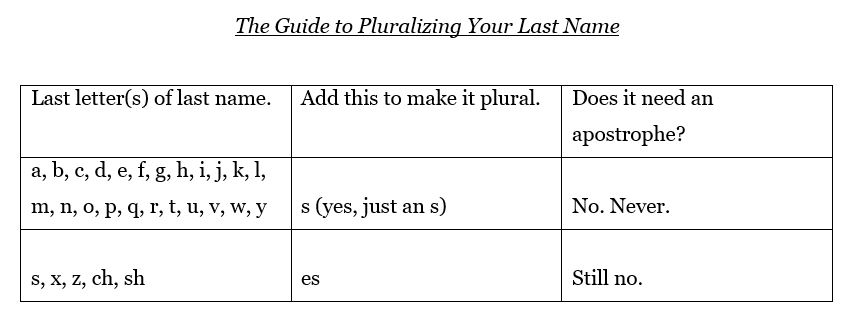
Holiday cards are a “to do” on many people’s 2022 year-end list. So, it’s time for an old favorite: the guide to properly pluralizing one’s last name.

It’s way easier than it seems. Just add an “s.” That’s it. No apostrophe, no special symbols. Just add an “s.”

As simple as it seems, my delivery of cards this time of year indicates otherwise. Remember, writing “Happy holidays. We love the Diorio’s” makes one ask, “Love the Diorio’s … what?” since the apostrophe and the letter “s” indicate possession of something. But rather than getting myself tied up in knots explaining things, here is the popular guide to pluralizing your name.

It’s Season in Southwest Florida

One Southwest Florida term that is lodged in my brain comes from a headline in the November 7 edition of the News-Press that read, “What will season bring in Southwest Florida this year?” The word “season” is a noun, and the headline reads as though the word needs a modifier, like tourist season, winter season, etc. I asked the reporter who wrote the story about the term. She explained it is a local idiom generally referring to fall and winter when tourists and “snowbirds,” or people who own a home up north, return to Southwest Florida to escape the winter cold.

The use of “season” as a shortened, aw-you-know-what-I-mean version of “tourist season” is a form of truncation. For example, the word “microphone” is shortened to “mic.” Fans of the National Football League’s Cincinnati Bengals truncate the word “they,” saying “dey,” as in “Who dey think is going to beat the Bengals?” Cincinnati broadcast sports reporter Sara Elyse truncates it even further. When the Bengals played the Titans on November 27 she Tweeted, “It’s a great DEY for the Bengals to beat the Titans.” All this shows that language is influenced largely by where you are standing at the time.

New words for Scrabble

Good news Scrabble fans. There are now 500 new words available for use with the popular board game. Among the new words (many of which we have used for some time) are “guac” (short for guacamole), “zedonk” (a hybrid between a zebra and a donkey), and “Jedi” (and we can’t be friends if I have to define this one).

One of the new words available for Scrabble is “gaslighting,” which Merriam-Webster also dubbed the 2022 word of the year. Gaslighting is defined as mind manipulating, grossly misleading, or downright deceitful. It’s worth 17 points in Scrabble, but I personally find it sad that, for two years in a row, words with potentially negative connotations have become the word of the year; the 2021 word of the year was “vax,” as in vaccination. 

When in doubt (read my book)

“Is it re-open or reopen?” someone asked via Twitter recently. For me, this is an easy one. It’s reopen, so says Merriam-Webster and Oxford. Like I say in my book, I don’t automatically know this stuff. I just look it up.

Did you read the subject line?

By Joe Diorio

I hate writing email subject lines. I know they are important, but I find writing them to be a soul-draining exercise. Just once I’d like to write, “Read this, dang it” and see what happens.

I know, I know. The subject line is the most important part of your email. It draws the reader in, right? Make them want to click “open,” right?

Yeah, yeah. I still hate doing it.

That said it is with a bit of hesitation that I cite some subject lines from political fundraising emails that caught the attention of a journalist colleague. Not because they’re good, but because their writers probably have my mindset about writing subject lines.

  • “A hard e-mail to write.”
  • “Don’t freak out”
  • “SURGING”
  • “I quit”
  • “coming to you directly”
  • “We need to do something drastic and ambitious”
  • “unacceptable”
  • “This email is just four sentences” (Translation: Please read this.)
  • “genuine risk of losing”
  • “please”

Because we all write so many emails, I’m going to go out on a limb and say we are all guilty of writing a bad subject line now and then. That said, what makes for a good subject line?

“You need to appeal directly to your reader’s interests,” explains Holly Wexler, senior associate director, Wharton External Affairs, at the University of Pennsylvania. “Your subject line should reflect the content and be relevant; an update or an important message from a recognizable person.”

Recognizability indeed works. The University of Georgia’s Development and Alumni Relations team finds that solicitation messages from Kirby Smart, head football coach at Georgia, have very robust responses. Ashley Crain, a communications coordinator in Development and Alumni Relations for UGA, said the emails from Coach Smart generate some of the best responses.

Wexler shared a handy “to do” list of what to keep in mind when writing subject lines, such as utilize personalization, use recipient-specific words (be meaningful to the reader), use caps sparingly so your email doesn’t get marked as spam, and limit your use of exclamation points. (Note: Benjamin Dreyer, author of Dreyer’s English, advises that one should use no more than 12 exclamation points in a lifetime. Not a bad goal to keep in mind if you ask me.) Before leaving this subject, here is a shout out to Jadrian Wooten, a professor of economics at Virginia Tech, who wrote an email to his students in the style of a political fundraising email:

SUBJECT: Kiss your THURSDAY goodbye

I posted about it in the syllabus.

I reminded you in class all week long.

I posted an announcement in Canvas about it.

And now I’m emailing you – AGAIN – because with twelve hours left before the deadline for your assignment, things have gotten more serious.

I’ve just learned that half of the class STILL hasn’t start (sic) the assignment due tonight and this could potentially DESTROY your ability to enjoy your Thursday night. This is absolutely unbelievable.

We’ve tried setting all the due dates in advance. We’ve tried keeping the due dates consistent during the semester. But now we need you to act. Please, this is a make-or-break moment. Will you start your homework now before we get too close to the deadline?

Literal interpretations

Loved this exchange captured on the Twitter feed for @kctorawrites:

Me: (cooking with 9yo) Okay, pour in the evaporated milk.

9yo: If it was evaporated, it wouldn’t be here.

Me: …

Writing to be understood can be harder than you think. An elementary school teacher in Southwest Florida recently asked her students to write out instructions on how to make a sandwich with Nutella. One student diligently wrote, take a slice of bread and put the Nutella on it. So, the teacher placed a slice of bread on a plate, then placed the jar of Nutella on the bread. She followed directions, right?

Let’s write carefully out there, people.
Joe Diorio is a writer living in Fort Myers, Florida. His TRIPLE award-winning first book, A Few Words About Words, is available now.

On the horizon – a new lexicon of language

By Joe Diorio

On July 21, The New York Times reported Dr. Henry Louis Gates was spearheading the creation of the Oxford Dictionary of African American English. I’m a sucker for reference books, and Dr. Gates’ project sounds like it has the academic chops to be worthy of joining a reference library.

For perspective, I asked Daniel Upchurch, Ph.D., chair of the psychology department at Morris Brown College in Atlanta, to share his thoughts. Dr. Upchurch’s perspective follows:

“When I read that Dr. Henry Louis Gates was overseeing the Oxford Dictionary of African American English, I was excited to see something of that nature being produced, but I was slightly perplexed by the implementation of the text. There are several questions that need answers before supporting something of this magnitude. First, will this dictionary cover multiple generations of words, or will it document terms that are already used through the United States? In addition, would this be an acceptable text in the classroom, whether in elementary or in college. Remember, students may logically say, ‘well, it’s in the dictionary so it must be a word.’ Would this change the entire grammatical structure?

“Nevertheless, this dictionary could address the issue with marginalized and underrepresented groups and standardized testing. When looking at testing, minorities will usually perform higher on fluid intelligence items versus crystallized intelligence items (fluid intelligence is the ability to think and reason abstractly and solve problems; crystallized intelligence involves knowledge that comes from prior learning and past experiences like vocabulary and reading comprehension). A great example I use when teaching on crystallized intelligence is the sofa and couch story. A child is asked, ‘what furniture is soft, cozy and you can lay down on it?’ If the choices were sofa, stool, and chair, some may select sofa, while others may have a hard time selecting the correct answer, possibly because ‘couch’ may be a more familiar word instead of a sofa. The moral to the story is that some cultures see things in different ways, and it is important to remember that culture is not simply tied to race, religion, beliefs, and values, but also History and generation.

“Words that are passed down from generation are altered and spoken in different ways. For some, it’s their way of communicating. For others, it is a form of community that allows individuals to relate to one another. The ultimate barrier is when an individual must travel outside of their community and try assimilating into another. The questions that may considered is, ‘Do I code switch, and will this transition be acceptable in my community?’ In addition, “Will my original language be acceptable in other settings?”

“The answer to those questions may vary, but one thing is for sure, establishing a dictionary on African American English would provide scholars in the respected field more information on the Black culture which may limit their levels of encapsulation. It could also be a way to better assess crystallized intelligence of African Americans and allow researchers the opportunity to obtain additional and respected literature on the Black community. However, I would suggest that experts in this field monitor the implementation carefully and use a collaborative model that involves the community, experts, school systems, and focus groups.” 

More on Dr. Upchurch.

Copy editing matters

One evening in 1960, a novice copy editor at The Wall Street Journal was hard at work when a rumpled old man shuffled up to him. “What are you doing?” asked the rumpled old man. “I’m trying to change some things here to make it more understandable,” said the novice editor.

“Good,” said the rumpled old man. “The easiest thing for the reader to do is to quit reading.”

As the rumpled old man shuffled off the novice copy editor asked a co-worker, “Who was that guy?”

“That’s Barney Kilgore, he runs the place.”

Kilgore was the managing editor of The Journal from 1941 to 1965. He also was the head of the Dow Jones Company. He thoroughly understood the need for good editors, as this article demonstrates. Let’s hope the understanding of good copy editing never goes away.

Hurricane Ian Relief

Hurricane Ian blew through Southwest Florida on September 29, causing damage that is beyond anyone’s comprehension. Our home was not damaged; we were just without electricity (or cell phone service – digital withdrawal is real) for three days. Most other people were not so fortunate. Southwest Florida looks like it went a few rounds with Mike Tyson. People are hurting. Please help. Here is a link to the Southwest Florida Community Relief Fund. One hundred percent of every donation goes directly to people in the community.

Let’s write carefully out there, people.

Joe Diorio is a writer living in Fort Myers, Florida. His triple award-winning book, A Few Words About Words, is available wherever fine books are sold.

A TRIFECTA OF AWARDS FOR A BOOK ABOUT GRAMMAR

Joe Diorio’s first book (and he’s 66 #NeverTooLate) wins Music City Gold Pen award for writing

A Few Words About Words: A common-sense look at writing and grammar by Joe Diorio, has won a Music City Gold Pen award for best writing from the Nashville chapter of the International Association of Business Communicators (IABC).

The award recognizes the book, published in August 2021 through Beaufort Books, as the best in the category of writing.

“Writing is a pure communication skill, so it is an honor to receive this recognition,” said Diorio, who wrote the book while living in Nashville. “The basis of any social media post, TikTok video, or any other communication is good writing.”

This is the third award the book has received. It has already been recognized as a notable title in the Shelf Unbound 2021 Indie Best Awards competition, and it is a bronze winner for humor in the from the 2021 Foreword INDIES Book of the Year competition.

It is Diorio’s debut book and takes a serious but humorous look at writing. Readers describe the book as “William Safire meets David Sedaris.” It is based on a monthly blog of the same name and talks about writing and grammar through the eyes of someone who had to teach himself the rules of grammar.

Excerpt: “I’m a master at writing around a grammatical problem. Do I need to say someone looked at the ceiling? Rather than tying myself up in knots over the ‘I before e’ rule to spell ceiling correctly, I’d just write, ‘He looked above.’ Is something effective or affective? ‘It really works,’ I’d write. Form the plural possessive of a noun? Don’t.”

The book has its share of practical advice, too like how not to start a social media post in which the writer wants to brag about an accomplishment:

“A quick scan of my news feeds on Twitter and LinkedIn shows the text in each post possesses the same banal monotony – ‘We are so proud,’ or ‘Today I had the chance to,’ or ‘This is super interesting,’ or ‘Humbled by (insert accomplishment).’ People, people, please stop! We can do better.”

A new resident of Fort Myers, Florida (he and his wife moved here from Nashville in May), Diorio has been a writer all his life. He wrote comic books as a kid (illustrated them, too), was a stringer for a local weekly newspaper in high school, worked for the college weekly newspaper, was a reporter for local daily papers in Connecticut, and he wrote speeches for executives with IBM and DuPont.

To help promote the book Diorio hosts a periodic Zoom-based “game show” where contestants answer a single question about grammar.

Available wherever fine books are sold, publisher Beaufort Books describes A Few Words About Words as the “go-to-grammar guide you pick up and can’t put down.”

###