I am stubbornly sticking to it

By Joe Diorio

My second book, Crisis Communications and the art of making nothing happen (Beaufort Books), turns one-year-old on January 7.

It has succeeded despite a lot of roadblocks thrown in the way.

First, my publisher took over a year to agree to publish the manuscript. I submitted a proposal in Spring 2022 and didn’t hear until almost the Summer of 2023 that it was a go. All along my editor said it was on her radar, but if so then it must’ve been ground clutter.

Second, the publication date kept getting pushed back; October 2023 to later in 2023, then to January 2024 and – if I hadn’t thrown a polite tantrum (let me go no further than that on this topic) – it might have been pushed back even further.

Third, Advance Reading Copies (ARCs), which are used to generate early reviews of the book, were delivered so late that few early readers got a copy. I resorted to emailing volunteer readers a PDF of the edited manuscript.

Fourth, fewer than one third of the people who agreed to write reviews did so. I am not going to drop names, but you know who you are.

And finally, for the initial print run my publisher ordered only 500 copies. Yes, just 500 copies. The size of a press run for new books varies, but usually at least 2,500 to 3,000 often comprise a first pass. My first book, A Few Words About Words. A common-sense look at writing and grammar (Beaufort Books, August 2021) had about that many copies printed. Crisis Communications had just 500. Say you have no faith in a title without saying you have no faith in a title.

But remember at the outset I said it has succeeded? It has.

For starters, people who have read the book – and it has sold just over half of the press run – love it. Not just like, love. A friend relayed the story that she sat down in a diner to have breakfast one morning and started reading the book after she ordered her meal. She tells me she was so taken in by the book that her server gently tapped her on the shoulder to ask if everything was OK.

“Yes, I’m fine. Why do you ask?” my friend asked.

“Because your food was delivered 45 minutes ago and you haven’t touched it,” the server said.

Yes, the book can be THAT engrossing.

Crisis Communications is a story about how a business survives a mass shooting. I wrote the book as fiction, basing it on personal experience. Yes, I was in a mass shooting. It sucked.

I thought the book would appeal to professionals in the communications field because they often spearhead the development of a crisis communications plan. And since over 30,000 people in the United States work in some form of public relations or communications, I figured that was a sizeable market. I also thought people working in the news business would like it since the book provides a glimpse at what goes on in a company behind the press conference.

To use an overused cliché, well I wasn’t wrong. A friend who wrote the forward for the book called it a “master class” on crisis planning.

This past August Crisis Communications won the President’s Award from the Florida Authors and Publishers Association; it was roundly applauded by readers. It was (and still is) a good book.

And I have faith in my book. Both of my books, in fact. So much so that I am donating all royalties from both books to food bank charities throughout the United States, figuring I can help people and maybe sell a book or two.

Sure, you can just donate directly to a charity, but buying the book helps a charity and it helps you hone your skills.

Crisis Communications is the book a public relations professional would want their crisis planning reluctant client to read (or at least summarize it for them). Reviewers recommend it for both educational and its entertainment value.

“This book provides an education on the importance of communications and PR when tragedy strikes a company. There’s more behind a story and this book reminds us of the importance of controlling the narrative or someone else will,” one reviewer said.

“Joe writes from both training and experience. His central point is the most important – be prepared in advance,” another reviewer wrote.

As for A Few Words About Words (AFAW), remember that at one time or another we all must put pens to paper, fingers to keyboard, or thumbs to a smart phone. I tell parents that AFAW is a great summer beach read, too, since many of us will have to help our kids write their annual “What I did on my summer vacation” essays.

So, I am sticking with my books. And why not? Who abandons a one-year-old?

Let’s write carefully out there, people.

Joe Diorio lives in Lee County, Florida and will gladly send you an autographed copy of his book in exchange for a review on Amazon. Contact him at diorio@comcast.net.
A Necessary Redo

By Joe Diorio

I’m writing a new edition of A Few Words About Words. Here’s why.

Joe Marshall was a lifelong corporate communications professional who loved the written word. He first worked as a newspaper reporter in Poughkeepsie, New York; then later with the International News Service, Newsweek magazine, and the legendary New York Herald Tribune daily newspaper. In those jobs, and later as a communications manager with IBM, he was renowned for producing the clearest and easiest to read prose. His fixation on letter perfect copy also drove more than a few people who worked with or for him crazy.

Imagine being a low- to mid-level corporate communications professional tasked with writing and producing a brochure or newsletter on some new tech IBM was about to introduce to the market. This always was a huge undertaking at IBM. Creating the newsletter or brochure or even the basic press release announcing the new widget was an experience tantamount to jumping through hoops of fire and landing barefoot on shards of glass. Honest, you were trying to get product managers to talk to you in non-jargon terms, then tell you why their latest and greatest product mattered and differed from its predecessor and similar products from the competition, explaining everything in layman terms (it would have been easier to ask them to stop breathing), then write something in Associated Press style (not heavily laden with jargon and at a ninth grade reading level) and get it ready for design.

After doing all that you had to repeat the whole process – only this time you also feel like you are a clay pigeon at a skeet shooting center – in order to get what you wrote approved, develop a design for the brochure everyone agrees on (this often involved keeping graphic designers awake all night to make last-minute changes), and doing it all within a prescribed budget and deadline.

When you finished going through this communications torture chamber, when you are just about to let the printer start the presses, Joe Marshall would say in his high-pitched raspy voice, “Can I have a look at what ya got?”

Those nine words would make you tense up and grit your teeth. But because he was your boss, you’d hand Joe the work you have literally been bleeding at the fingertips to produce and waited. Five minutes later (Or less, he was a quick read.) Joe would come back to you and say, “Ya know what this needs?” Typically, that “need” required a wholesale rewrite of everything. It meant you were once again going through the torture chamber of approvals.

You would gnash your teeth. You would resist the urge to strangle him. (Which at times was tempting; Joe wasn’t a physically big or imposing man.) But then you would stop yourself, look at his notes and think about what he was asking you to do, and you would realize: He’s right. If I don’t do what he’s asking, then I’m settling.

Joe didn’t want you to settle. In his mind, “good enough” never was good enough. And, when all was said and done, you didn’t want “good enough,” either.

It’s been nearly 40 years since I worked with Joe. I realize his changes – often the wholesale rewrites he made you do – always made my work better. I wasn’t settling for good enough.

I thought of Joe when I set about creating this new edition of A Few Words About Words. Yes, the first edition was good. But as I said more than once in that book, language is a forever evolving thing. We didn’t have artificial intelligence producing copy for us when AFWAW was published, we found emojis were increasingly becoming a permanent part of our communications toolbox, phrases and terms that were so much a part of the COVID-19 pandemic did not stick around (some did; for example, we now Zoom all the time), and there were questions about punctuation and word usage that more than a few readers of A Few Words About Words say they were looking for.

 We work with the written word even more today than we did just three years ago. So, a second edition – not one that just has some additional material tossed in – made sense.

In doing another edition I committed myself to Joe’s prodding and refused to settle. Getting it right is worth the effort. And today I’m the only one making myself jump through hoops and walk barefoot on shards of glass. It still hurts, but it is worth the effort.

Joe passed away in 2018 at the age of 91. Somewhere, he’s looking down at me – probably in between suggesting to Saint Peter that parts of the Bible could use some editorial “massaging” – and he’s smiling.

Thanks, Joe, for making sure I never settle for good enough.

Joe Diorio is the author of A Few Words About Words: A common-sense look at writing and grammar (Beaufort Books, 2021) and the forthcoming Crisis Communications and the Art of Making Nothing Happen (Beaufort Books, January 2025).

Political Bingo

By Joe Diorio

The 2024 presidential election is underway, as is the proliferation of political jargon we read and hear. Mind you, the offenders of using said jargon are not just news reporters. It’s everywhere. Political pundits and reporters alike are tossing around terms like “War Chest,” meaning money accumulated in advance of a political campaign; RINO, meaning a Republican In Name Only; PUMA, or “party unity my ass;” and “Battleground state” or “Bellweather state,” meaning turf that is either fought over or sure to be won.

Some terms have been around forever. “Plank,” for instance, refers to a position a political party takes on an issue; said position is said to be a part of – or a plank – of the party’s platform. “Taking the gloves off” goes back to the early 19th century and was not originally relating to politics.

The terminology is thrown about so much, and often without thought, that perhaps it is a bit overdone. Just look at a newspaper, a news feed on X, or turn on the evening news and an overdone political term is sure to come up.

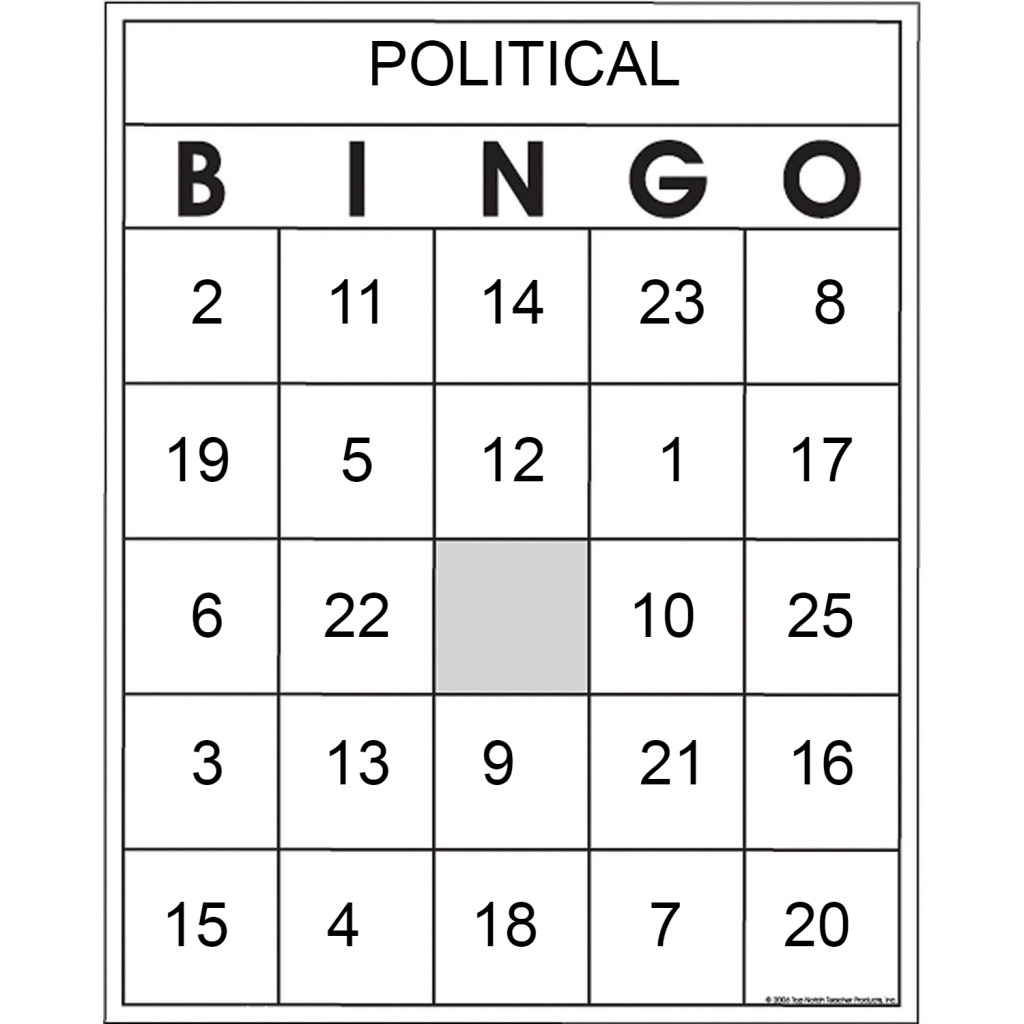
I am so confident of this that I have created a game of political jargon bingo. Download and print the Bingo card accompanying this post. Since it is a jpeg picture file you may need to paste it onto a Word or Google document. Also keep the list of 23 political jargon terms. Then keep an eye on the news – print, broadcast, or social media. Every time a jargon term on the list is mentioned, mark the Bingo card. I used numbers because some of the terms are too long to fit on a Bingo card.

When you hear something like “Taking gloves off,” mark the square with #2 because that’s the number corresponding to the term “Taking the gloves off.” Once you get a straight or diagonal line (the center square on the Bingo card is a free space; you’re welcome) you win.

The first three people to fill out their Bingo cards – the first three who do it and tell me about it, I should say – win a signed copy of my book, A Few Words About Words.

Here’s the Bingo card.

And here is the list of jargon.

Political Bingo. How many of these terms have you heard?

1. Gearing up for

2. Taking the gloves off

3. Stump speech

4. Battleground state

5. Bellwether state

6. Coffers

7. Dark money

8. Inside the beltway

9. PAC

10. War chest

11. Wedge issue

12. Flip flopper

13. Lame duck

14. Malarkey

15. Fake news

16. RINO

17. PUMA

18. Pivot

19. Dog whistle

20. Throw their support behind …

21. Balanced ticket

22. Astroturfing

23. Plank

24. Party apparatus

Have fun. And let’s write carefully out there, people.

Joe Diorio is a writer from Fort Myers, Florida. He is the author of “A Few Words About Words” (Beaufort Books, 2021) and the forthcoming “Murders at Trask: Crisis communications and the art of making nothing happen” (Beaufort, 2024)