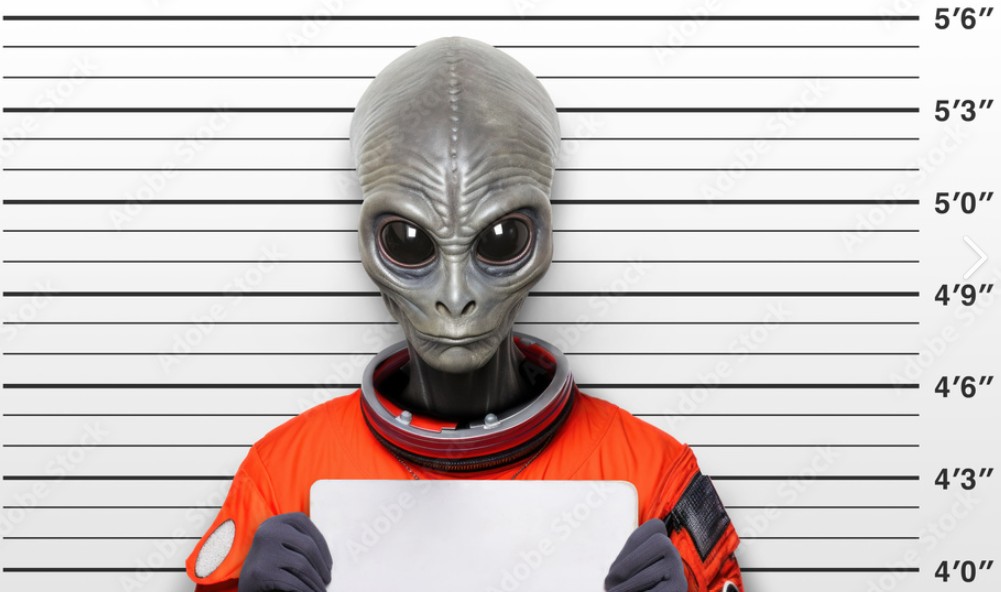
By Joe Diorio
From the introduction of my fourth book, The Ultimate Illegal Alien (in development.)
Science fiction storytelling is the perfect tool to point out the absurdity of a situation.
The Twilight Zone episode titled “Eye of the Beholder” was about a woman who had facial surgery to make her look “normal.” Indeed, she looked perfectly normal when her bandages were removed, UNTIL you saw the doctors and nurses. She was in a society of people whose faces are anything other than the accepted norm. Everyone except her had drooping facial features, thick brows, sunken eyes, swollen lips, and snout-like noses. To everyone in this society, this “look” is normal. It is the woman, portrayed by an attractive young blonde, who is considered disfigured.
The episode was aptly titled, since everyone thought it was the young woman who was disfigured. The episode called into question what beauty is and who makes that decision.
Nine years later Star Trek aired the episode, “Let this be Your Last Battlefield.” It told the story of a 50,000-year-old civil war between citizens of the planet Cheron, a war with blatantly absurd origins. Part of Cheron’s population had a skin coloration that was dramatically different from the other part of the population. Everyone on the planet bore a striking physical appearance—they had white skin on one side of their body and black skin on the other. This color difference was not subtle. There was a clear line of demarcation between the two sides, as though someone had used masking tape to make the line. (Truth be told, in the makeup chair someone probably did exactly that.)
One half of the Cheron population had black skin on the right side; the other half had black skin on the left.
And each side hated the other because of this difference. Each felt their pigmentation was normal. This raised racial stereotype prejudice to a striking level of absurdity. As with any absurd situation, there was no resolution to their difference.
The Twilight Zone and Star Trek stories demonstrated the power of storytelling in a science fiction setting. All storytelling can bring out the obvious. Science fiction storytelling can make the obvious seem absurd.
Nowadays we find many amongst us in a heated argument about immigration. Who stays in the United States and who cannot? Managing immigration in America has gone on for over a century and has never had a pretty face. Since 2025, the face has become uglier than most dared to imagine. Daily news feeds seem to contain a regular dose of immigration agents chasing down and arresting people, protestors violently clashing with immigration agents who use tear gas and flash bang grenades, even live ammunition to disperse protesters. Arguments presented to defend this action have become as unwatchable as the events themselves. And all the immigration tactics are undertaken under the guise of keeping the country safe.
So, if Star Trek and/or Twilight Zone writers were to sit at their keyboards to write a script for immigration, then what would they write? How could science fiction depict the situation? Rather than a government trying to forcefully keep people out, what about an alien planet forcefully bringing people back to their home world?
I imagined a scenario where citizens of a planet visit other worlds and sometimes must rely on a paramilitary force from their home planet to rescue them should the need arise. What if that rescue was not necessary and there was a misunderstanding? Imagine the home world using individual homing beacons on citizens traveling to other worlds, and if a homing beacon stopped working the home planet would move to rescue their citizen, using violent tactics if necessary.
If alien rescue efforts were to turn violent, then what happens? Rather than guns, tear gas, and flash bang weapons wielded by masked ICE agents today, space helmet-wearing alien rescue teams might be armed with powerful laser weapons or something even more destructive. If forced to use such weapons, the devastation they cause could be catastrophic. The ugly face of this reverse immigration enforcement would be a shock and awe experience for the planets these rescue teams visit.
Whether it is masks, gas cannisters or helmets and laser weapons, such tactics would be polarizing for anyone looking on from near or afar. At first the two sides would be “either you agree with it or it is horrifically inhumane,” but in a science fiction scenario this may morph to intergalactic condemnation.
Can anything create a softer edge to immigration enforcement?
Public relations can positively influence a situation. It can educate a public and build an informed basis from which people can make up their own minds. But it cannot on its own change minds, especially when the answers are rarely black and white. Yet sometimes with thorny subjects P.R. becomes a tactic.
That was my starting point for this book. Immigration in the United States, and a reverse immigration taking place on another planet. Both the U.S. and alien immigration officials face heat from their superiors, from the public, and from other sources over their tactics, yet they insist what they are doing is keeping everyone safe.
What would happen if each side decided to try some public relations to smooth over their rough exteriors? Would that work?
Let’s find out.


