My Blog

What do you call Santa’s elves? Subordinate clauses.

ChristmasInSouthPhilly_1

By Joe Diorio

Time to dip into the old cliché bag and roll out some holiday word nuggets.

Rudolph, the red-nosed caribou: Yep, the correct name for Santa’s reindeer is caribou. The word “reindeer” has roots in the 15th century from an old Norse word that grew out of the phrase “hreinn reindeer,” which was used to identify a male caribou. You can thank the advertising team at Montgomery Ward department store in Chicago for creating the story of Rudolph. The tale of the red-nosed caribou was used by the retailer in its 1949 holiday advertising campaign and was later converted into the well-known song. Bonus points for anyone who knows the name of the singer who first recorded the song. (And, no, it wasn’t Gene Autry.)

Baubles hanging from the tree: A bauble is defined as a trinket. Its origin goes all the way back to the 14th century and referred to a piece of jewelry, as in “he affixed the bauble, with a kiss, upon her finger.” It was Sir Walter Scott who referred to the scepter brandished by a court jester as a bauble. Interestingly, an ornament for a tree is the fourth and final definition offered up by Merriam Webster.

We kiss under the mistletoe, why: Mistletoe is considered a hemiparasitic plant that grows on pine, oak, birch and apple trees. It’s called a hemiparasatic plant because it carries out photosynthesis independently but obtains water and minerals from the tree it is attached to. So basically, it’s a leech. The business of kissing beneath mistletoe came from a Celtic tradition of placing a small amount of it above the door of homes during the winter as a sign of life despite the dreary weather; mistletoe remains green throughout the winter. The thought was hanging it over the doorway ensured harmony within the premises.

Gold, Frankincense, and Myrrh. Or, in current terminology, money and first aid: Think about the gifts from the three wise men. Gold, I get; giving money as a gift is both safe and a no-brainer. WebMD defines frankincense as a hardened gum-like material that is made from cuts in the trunk of a Boswellia carteri tree. WebMD also describes myrrh as a resin from bark resin, and is used to treat indigestion, colds, even colic. Having experienced a baby with colic, I know that’s a gift worth more than gold. Money and medicine; those three were truly wise.

And the holiday writing honor goes to …

In 2018 I cited the wonderful work of Ysabel Yates, who penned a noir-esque critique of Rudolph the Red Nosed Reindeer in The New York Times. My favorite line: “His nose glowed like the end of every cigarette he swore would be his last.” This year I turn the spotlight to a great piece written 13 years ago by Steve DiMeo, a writer and marketing pro in Philadelphia. Steve took the classic “A Visit From St. Nicholas” and reimagined it, South Philadelphia style. “A Visit From Uncle Nick” is a fun read even if you are not from Philadelphia. Some snippets:

Da brats were outta hand
From eatin’ too much candy.
We told them to go to bed
Or there wouldn’t be no Santy.

And me in my sweatpants,
Da wife’s hair fulla rollers,
Plopped our butts on the sofa
To fight over remote controllers.

When out in da shtreet,
There was all dis friggin’ noise.
It sounded like a mob hit,
Ya’ know, by Gambino and his boys.

The full poem is on my website.

Happy holidays, and let’s write carefully out there, people.

Joe Diorio is a writer living in Nashville, Tennessee. Before that he lived in the Philadelphia area for almost 30 years and can strut with the best of them.

 

Not a creature was stirring, save for those darn apostrophes

Christmas Landscape

By Joe Diorio

The holiday season is upon us. Or at least it has been since late September when my local Walmart put out its first Christmas decorations. But more important than the over-commercialization of the holiday is what showed up in my mailbox the other day. It was a Christmas card with the following written inside:

“Happy holidays! We love the Diorio’s.”

Wait! Love the Diorio’s … WHAT? Our humor? Our address? The way I make mountains out of grammatical molehills?

I take issue with the last item. It seems knowing how to make one’s last name plural has gone the way of waiting until your second slice of apple pie after Thanksgiving dinner before playing any Vince Guaraldi Trio Christmas music.

“Diorio’s,” as it appears on the card, is possessive. Simply adding an “s” at the end, Diorios, makes it plural. I suspect the author of this card – who is no doubt removing me from their Christmas card list as they read this – meant to say “Diorios” rather than “Diorio’s.”

Since it appears to be that hard to make someone’s last name plural rather than possessive, and I suspect more than a few of us will be sending Christmas (OK, HOLIDAY) cards this year, I offer to you a great guide developed by Kate Brannen that was recently published in Slate. Brannen’s (see? That’s possessive) column offers a user-friendly guide to making a last name plural. Written way better than I could ever hope to write, the full column appears here.

Enjoy the holidays and let’s write carefully out there, folks.

Joe Diorio is a writer living in Nashville, Tennessee. He hasn’t started addressing his holiday cards yet.

SUBSCRIBE TO MY NEWSLETTER


Yo, Adrienne, what’s that clatter?

Rocky_Statue

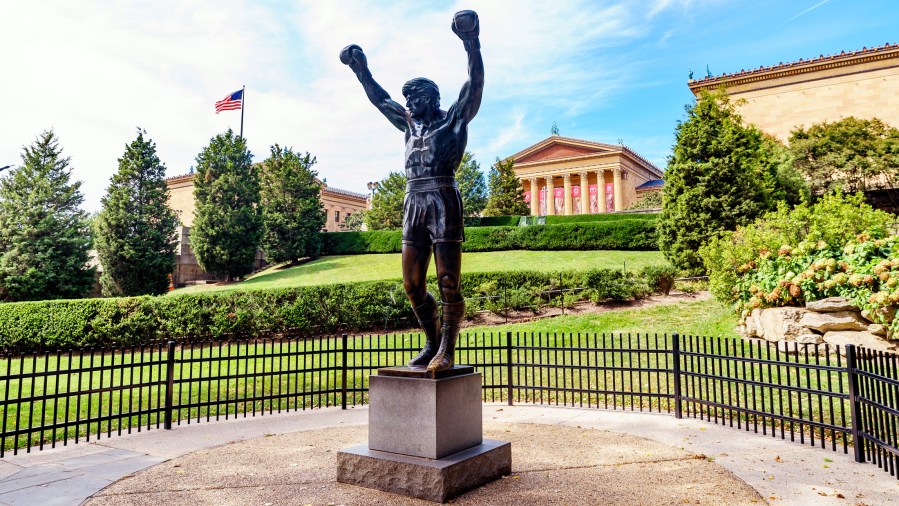
Philadelphia is the City of Brotherly Love. It also is a place ripe with stereotypes, from Rocky Balboa running up the steps of the Philadelphia Art Museum to the late comic David Brenner making jokes about growing up in Philadelhia’s edgier neighborhoods. (“Fabbio are you from Philadelphia, too?” he once said, quickly following it up with, “Did you steal my bike?”)

In 2006 writer Steve DiMeo, who I had the pleasure of working with at an advertising and public relations agency in Philadelphia, put pen to paper to re-imagine the holiday classic “A Visit from St. Nicholas.” What follows is his wonderful rendition of the holiday favorite.


Christmas in South Philly

A Visit From Uncle Nick

or, “’Twas? What da hell kinda word is ‘Twas?”


By Steve DiMeo


‘Twas da night before Christmas,

You hear what I’m sayin’?

And all through South Philly,

Sinatra’s Christmas tunes was playin’.


Da sink was piled high,

Fulla dirty dishes,

From da big Italian meal

Of gravy and seven fishes.


Da brats were outta hand

From eatin’ too much candy.

We told them to go to bed

Or there wouldn’t be no Santy.


And me in my sweatpants,

Da wife’s hair fulla rollers,

Plopped our butts on the sofa

To fight over remote controllers.


When out in da shtreet,

There was all dis friggin’ noise.

It sounded like a mob hit,

Ya’ know, by Gambino and his boys.


I trew open da stormdoor

To look and see who’s who.

Like a nosy little old lady

Who’s got nuttin’ better to do.


In da windows of da rowhomes

Stood white tinsel trees.

And those stupid moving dolls

You get on sale at Kindy’s.


When what should I see,

Comin’ from afar.

But fat Uncle Nick

In his big ole Towne Car.


He was swervin’ and cursin’,

Givin’ all da gas he got;

As he barreled up the shtreet,

Looking for a spot.


More faster than Santa,

My drunk Uncle came;

Wit’ a car full of relatives,

All drunk just the same.


“Yo Angie! Ay Dino!

Vic, Gina, and Pete,”

He yelled out there names,

Then spit a loogee in da shtreet


“I can’t find no spot nowheres,”

Pissed off, he said.

So he double-parked the Lincoln,

And came in to hit da head.


As he hugged me, he burped,

And passed a loada gas.

It stunk up da house,

Like a rotten sea bass.


His coat was pure cashmere,

His pinky ring shined;

His toupee was all twisted,

The front was now behind.


He ran up to da bathroom,

Bangin’ pictures wit’ his hips.

Never lettin’ da smelly stogie

Fall from his lips.


With eyes oh so bloodshot,

And a butt, oh so flabby;

In walked Aunt Angie,

All dolled-up and crabby.


“D’jeat yet?” she asked,

As she thundered to da kitchen;

“All da calamari’s gone?”

Aunt Angie started bitchin’.


In came Cousin Gina,

In Guess jeans too tight.

She was bathed in Obsession,

Her hair reached new height.


In strut Cousins Dino,

Little Petey and Big Vic;

Shovin’ pizzelles down their throats,

It was makin’ me sick.


I said, “How da hell

Are all youse people doin?”

Not one of them answered,

They was too busy chewin’.


Uncle Nick came down at last.

His face was beet red.

“Sorry I missed da toilet.

I pissed in the bathtub instead.”


That was it, I had had it.

I yelled, “Get the hell out.”

Uncle Nick looked real puzzled.

Cousin Gina started to pout.


Wit’ that they mumbled curses,

And opened a Strawbridge’s bag.

And fumbled ‘round to find da gift

Wit’ our name on da tag.


I then felt kinda stupid,

As I thanked them for their gift.

But they stormed out da stormdoor,

All of them miffed.


We tore open da paper

That was taped on and on.

It was a bottle of Sambuca,

And half of it was gone.


But I heard him yelling

As he slammed on da gas.

“Merry Christmas, ya ingrate!

You can kiss my ass!”


Yo. Happy Holidays, a’ight?


© 2006 by Steve DiMeo


Brevity, the path to confusion

November Artwork_CORRECTED

By Joe Diorio

Brevity in writing is not always a virtue.

Example 1: Opponents of the Oxford comma ranted on Twitter recently over usage that appeared in a Vogue magazine headline, “Cardi B on Raising Her Daughter, Bernie Sanders, and Coordinating Outfits.”

“I cant believe cardi b named her daughter bernie sanders” (sic), one person wrote, thoroughly ignoring the rules of punctuation and capitalization. “Look what your precious Oxford comma did this time, nerds,” said another.

With respect, both individuals are wrong. If I write, “My daughter, Hannah, and Chelsea rented a house in Pensacola, Florida,” then one might mistakenly think my daughter’s name is Hannah. But if I add a sentence, “The three of them had a good time,” then you know my daughter is not named Hannah. The problem is not with the Oxford comma, but with a lack of enough detail.

Example 2: The subhead on The New York Times October 17, 2019 story about the death of U.S. Rep. Elijah Cummings read, “A son of sharecroppers, he fought tirelessly for his hometown, Baltimore, and became a key figure in the investigation of President Trump.” In this case, “Baltimore” is intended to be a parenthetical statement, but one could confuse the headline to be saying that he fought for two cities – his hometown AND Baltimore. This could easily be cleared up by saying “…he fought tirelessly for his hometown of Baltimore …”

Brevity is always good, but there can be exceptions. It is especially bothersome in social media. There, brevity often breeds snarkiness rather than insight.

That’s not just opinion. A study conducted by researchers at the University of Pennsylvania’s Annenberg School for Communication suggests longer tweets – 280 rather than 140 characters – breeds civility.

Professor Yphtach Lelkes and his team analyzed tweets from before and after Twitter implemented the increased character limit to 280 in 2017. They concluded that the average quality of conversation improved.

They defined quality as an ideal form of political debate, evaluating tweets for clarity, polite language, justification of opinions, and the use of facts or links to more information. They also evaluated whether users exchanged ideas rather than simply shouting insults at each other. It seems that the increased tweet length let people explain themselves; they could be more deliberative, polite, and civil.

Professor Lelkes says his findings might not apply across all social media. Facebook isn’t Twitter, he notes, and there are too many differences amongst various social media outlets. He’s using a grant from Facebook to study how different aspects of technology lend themselves to different conversations and actions.

By the way, Cardi B’s daughter is named “Kulture Kiari Cephus.” That’s six characters longer than “Bernie Sanders.”

Falling flat on pronouns

CNN’s Chris Cuomo tried a joke that fell flatter than a pancake recently. At a CNN LGBTQ town hall U.S. Senator Kamala Harris said her pronouns were “she, her, and hers.” This is a nod to the fact that non-binary individuals will use the plural pronouns “they, theirs, and them” in singular usage when referring to themselves.

Cuomo tried making light of Harris’ statement and said “she, her, and hers? Mine, too.”

First, please know that there is nothing new about using the plural pronoun “they” for singular usage. Emily Dickinson was doing it over 100 years ago. Second, identifying one’s personal pronouns is not some trendy idea. I participated in seminars on this topic whilst working at Vanderbilt University, where I learned this is a way to show respect toward others.

To his credit, Cuomo apologized for his gaffe. And, yes, “his” is indeed one of Cuomo’s preferred pronouns.

Channeling my inner Ask Abby, it is perfectly acceptable when meeting someone to not only say what your preferred pronouns are, but to ask the individual what theirs are as well.

A moment to brag

Last month a faculty member at Saint Joseph’s University asked if he could use my newsletter in his intensive writing class. Besides being flattered to the hilt, I think I left skid marks saying “yes!” Nothing beats having your work recognized by academia.

I sincerely appreciate all the feedback I receive. Please don’t hesitate to let me know what you think of A Few Words About Words.

Let’s write carefully out there, people.

Joe Diorio is a writer living in Nashville, Tennessee.

SUBSCRIBE TO MY NEWSLETTER!


People, it’s the dog

October_2019_Artwork

By Joe Diorio

I chuckled when I read the above internet meme about this song. Then I became dismayed when I asked a few people about it and found little consensus.

“‘Who had a dog’ is a parenthetical statement, no? So maybe the farmer IS named Bingo,” said more than one colleague.

To clear this up I did what everyone does: I asked Google.

That was a bad idea. Online forums like seebs.net and reddit.com offered discussion, and a few pop-up advertisements for managing a barking dog, but no real answer. Therefore my next step was to take a deep breath, dig deep in my memory banks, and diagram the sentence.

Stop laughing. It worked.

Diagraming a sentence represents basic grammar tactics. Identify the elements of the sentence: nouns (farmer, dog, name, Bingo), verbs (had, was), pronouns (his, who), adverb (there), conjunction (and), articles (a). Then lay things out on a horizontal line – subject, verb, direct object, with adjectives, prepositional phrases, and conjunctions on angled lines below – to show how they flow in the sentence. The first thing you discover doing that is the subject of the sentence is the farmer, the dog is a direct object, and Bingo works as an adjective to modify the direct object.

The result is that the dog’s name is Bingo. Email me if you want to see my diagram.

Besides, everybody knows the farmer’s name is “Old MacDonald,” E-I-E-I-O.

Punctuation Pugilistics

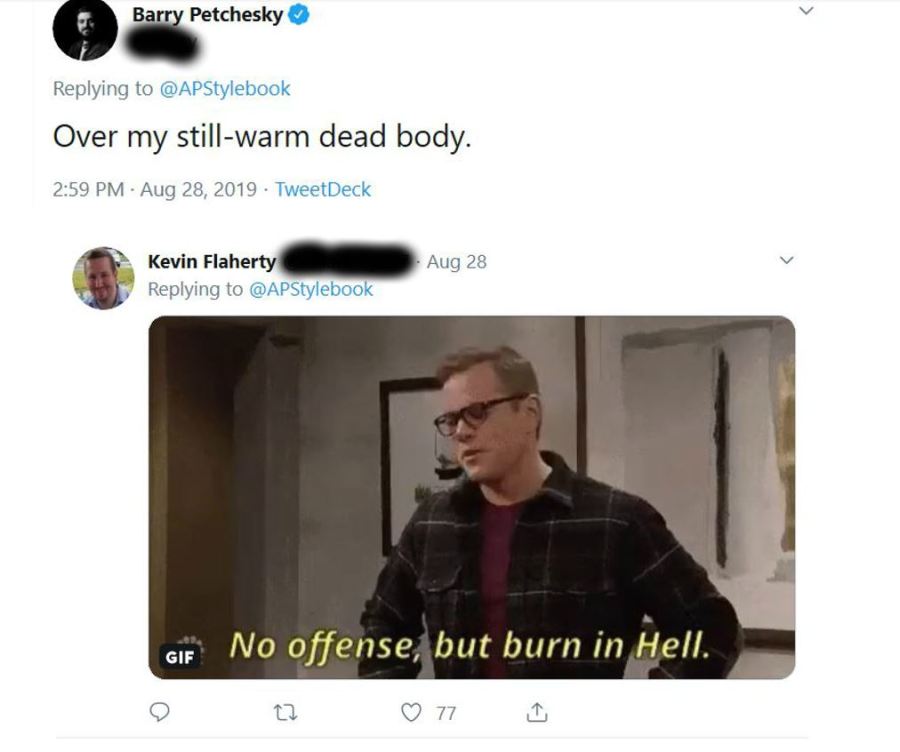
Earlier this summer the Associated Press decreed that compound modifiers no longer require a hyphen if the modifier is commonly recognized as one phrase and if the meaning is clear and unambiguous, as in “first quarter touchdown” rather than “first-quarter touchdown.” If Twitter is any indication, the change was not well-received (well received?).

October 2019 Artwork TWO

Welp, the people have spoken, and the @APStylebook listened. In a September 25 tweet it said “… upon further reflection and thanks to your feedback, we’re reversing that decision.” That’s a fourth-quarter comeback, for sure.

The rules of punctuation are bound to start arguments. For my part, I firmly believe that every time someone does not use the Oxford Comma, a puppy dies. But there I go digressing again.

Mark Twain was often criticized for his use of punctuation. In The Autobiography of Mark Twain he said his punctuation is “the one thing I am inflexibly particular about … it’s got more real variety about it than any other accomplishment I possess.” Rumor has it he also once wrote something, leaving all of the punctuation marks in the footnotes for the reader to sort out. Scholar Cecelia Watson, author of Semicolon: the Past, Present, and Future of a Misunderstood Mark, wrote that she attempted to find the story that is missing punctuation, but couldn’t. Still, reports of Twain’s antics are not highly exaggerated.

Let’s write carefully out there, people.

Joe Diorio is a writer living in Nashville, Tennessee.

SUBSCRIBE TO MY NEWSLETTER!