Emojis ARE punctuation

Survey identifies a continuing change in how language and writing are evolving

By Joe Diorio

FORT MYERS, FL (September 2025) – If you use an emoji at the end of a sentence – something 85% of us do – where does the punctuation go? Before or after the emoji?

            A survey suggests that emojis either go right after the sentence-ending punctuation, or they are replacing said punctuation altogether 😊

            Joe Diorio, author of A Few Words About Words. A common-sense look at writing and grammar (Beaufort Books) conducted an online survey in advance of National Punctuation Day (September 24) and found that:

  • 85% of the respondents use an emoji every time they write something.  
  • 14% said they use an emoji before the sentence-ending punctuation.
  • 40% of the respondents use an emoji at the end of a sentence instead of traditional punctuation marks – a period, a question mark, or an exclamation point. 😉
  • 46% said they use emojis after the sentence-ending punctuation. So, the period still has a slight lead on the no period group. Or are emojis becoming a new form of punctuation themselves?

“We continually evolve language through continued use,” says Diorio. “Email was once called ‘Electronic Mail.’ A phone was once called ‘the telephone,’ so it’s not surprising to see this change in punctuation taking place. What is cool is we get to witness language changing as this evolution happens.”

Using email or LinkedIn messaging, Diorio reached out to approximately 300 communications professionals – public relations professionals, journalists, writers – and asked them to participate in the survey. “The respondents are people who write every day, so they have a good feel for language,” Diorio said. Approximately one-third of those contacted completed the survey.

“This is a fitting observance for National Punctuation Day (September 24),” Diorio said. “Punctuation’s roots date back to the early days of the written word.  Someone reading printed text needed visual cues as to when to pause or when a sentence ends. Punctuation helps with the overall comprehension of the written message. Emojis are serving that same purpose, albeit with a bit more personality.”

A resident of Lee County, Florida, Diorio is the author of two books, the aforementioned A Few Words About Words, and Crisis Communications and the art of making nothing happen. Both are available through Amazon and other online resources.

Emoji Usage

Do you use an emoji before/after/in place of punctuation?

Contact:

Joe Diorio

diorio@comcast.net

610-291-2176

Harry Conjugation – Make My Day

By Joe Diorio

            Inspector Harry Conjugation from the Grammar Police (yes, “to serve and correct” is the department’s motto) parked his unmarked police car in front of the Donut Den in Nashville’s Green Hills neighborhood.

            “No damn hills to speak of and not very much is green,” he muttered to himself. Harry despised incorrect labeling. He exited his vehicle and strode inside to get his daily coffee and donut. “Yes, I’m a damn cliché,” he thought. He dropped the cigarette he was nursing to the ground and snuffed it out with his shoe before going inside. As he did every day, he swore to himself that one cigarette would be his last. It was a lie he kept repeating every day, too.

            Inside Loretta Scone was pouring Harry’s coffee. Ten years as a customer taught her how Harry liked his morning Cuppa Joe, “Cuppa Joe” being an iconic nickname dating back, or so history suggests, to World War I when Navy Secretary Josephus Daniels banned alcohol on Naval ships, therefore leaving coffee as the strongest beverage available. Sailors therefore referred to this shot of caffeine as their “Cuppa Joe.” Harry loved reminding himself of the lexigraphy of words and phrases.

            Harry looked at his smart phone (“And why is it smart? Doesn’t do a damn thing unless you tell it to.”) as Loretta finished pouring his coffee. She also slipped a sheet of paper, folded in a napkin, to him.

            Since Loretta never gave Harry a napkin (“Get your own damn napkin,” she was fond of saying to anyone who had to courage to ask her for one.) getting a napkin from Loretta made him take note. He looked closer and saw something scribbled on the napkin.

            Scrawled in red Sharpie were the words, “This is a ROBBARY”.

            Harry looked up over his teardrop shaped aviator sunglasses to see two nervous young men – wearing dirty sweatshirts and knit caps – sitting at one of the few tables the Donut Den has available to customers. He was less than 10 feet from them when he spoke.

            “You gentlemen have some explaining to do, don’t you?” Harry asked.

            Nervous kid #1 stood up, producing a switchblade style knife. “Explain what? To WHO?”

            Harry maintained his cool before speaking. “Well, for starters, you can’t spell very well,” Harry calmly said, pointing to the spelling of the word “ROBBARY” on the note.

            “And punctuation OUTSIDE of the quote marks? You really weren’t paying attention in English Grammar class, were you?” Harry took a few steps toward the two perps (“Perps” being a very old slang term for “perpetrator,” which has recently been replaced by police with the word “actor.” But c’mon, “perp” is just so much more fun to say. Whoops, I’m digressing again.)

            Nervous kid #1 decided he had heard enough and lunged at Harry, who deftly stepped to one side, produced his pocket-size super soaker and blasted the perp/actor with blue editor’s ink. The ink hit the kid square between the eyes.

            “AHHH, my eyes,” Nervous kid #1 screamed. “I’m not supposed to get editor’s ink in my eyes.”

            Harry shoved the kid aside with his foot and turned to Nervous kid #2 who was making a move toward Loretta.

            He never made it. Harry grabbed him by the collar, lifted him from the floor, bringing his face to within inches of Harry’s. Nervous kid #2 was sweating as Harry spoke to him through gritted teeth.

            “Look, punk, I’m tired of dealing with your kind. The kind who says ‘your’ when they really mean ‘you’re’ in a sentence. The kind who dangles modifiers. The kind who doesn’t care if he uses the Oxford Comma or not. You know how many puppies have died because your kind just won’t use the Oxford Comma? Well, do ya punk?”

            Harry was about to throw Nervous kid #2 aside when someone’s hand grabbed his arm.

            “That’s enough, Inspector Conjugation,” the voice was from Captain Eloise Editor, who has run the Bureau of Correct Grammar since before Ted Bernstein was a copy editor at The New York Times, or so goes the rumor. There was another rumor that she dated Benjamin Dryer, but let’s not get carried away here.

            Harry pulled away from his Captain. “These punks have to learn!” he said.

            “They’re not going to learn by browbeating the rules of grammar into them, Inspector. If that was the case, then everybody would be hiring Catholic nuns to run their schools.”

            “So, he’s just gonna be let go?” Harry said, pointing to Nervous kid #1.

            “Frist, stop dropping your gerunds,” Captain Editor said. “Second, no. He’ll go into a rehab grammar course and probably do some time in juvenile hall.”

            An approaching siren – several of them, in fact – caught Captain Editor’s attention. “Nashville Metro police,” she said. “Our work here is done.”
            Harry was not moving from where he stood. “They need to be corrected,” he protested. Their subject and verbs probably don’t even agree.”

            “We can’t change the world ourselves, Inspector. Just one blue mark at a time,” Captain Editor said as she and Harry left the Donut Den, driving away seconds before two Metro Nashville police cars pulled up. It was amazing that the traffic on Hillsboro Pike was light enough to let Harry and the Captain make a smooth departure.

The MNPD cops ran inside, finding Nervous kid #1 and #2 in a very submissive role.

            “What’s with all the blue ink on this one’s face?” one of the officers said, looking at Loretta.

            “Oh, that nut Harry Conjugation was here.”

            “HIM? Jesus Christ,” the police officer said. “When will that guy understand he isn’t the police. Did he do any damage?”

            “Yeah, he damaged my eyes, Officer Kelly” Nervous kid #1 said, looking at the name tag of the police officer who was standing over him.

            “Really? Your eyes are good enough to read my name tag, so it can’t be that bad. On your feet, punk.”

            “Hey, you’re arresting US? What about that guy Harry?”

            Officer Kelly shrugged. “He interrupted an armed robbery. He made a little mess with blue paint on your face. That’s about it.” Officer Kelly looked at the robbery note that Loretta handed him. “Jesus Christ, can’t you just use a generative A.I. system to write your stick-up notes? You know, one that knows how to spell?” The two perps were hauled off to justice.          

            A few miles away Harry was behind the wheel of his car, fuming at the world. He gripped the wheel tighter than a Boa Constrictor grips its prey and muttered.

            “People don’t write properly anymore,” he groused. “They’ll say ‘I’m like’ along with a sound effect or, occasionally a word. Or they start a sentence with ‘Let’s do this,’ not even bothering to put a subject noun in place.”

            He passed a billboard on Hillsboro Pike, offering cheap mobile phones and urging the reader to “Reach out” for a discount. “They can’t even say ‘contact,’ write to,’ or ‘talk to us’. Crap but the world is going to elucidation hell.”

            His radio squawked, “Harry, it’s Captain Typo. Let’s have a conversation about your conduct at the Donut Den.”

            Harry ignored the radio call. “Conversation, huh? He means ‘discussion’. Dude can’t even write. Next, he’s going to tell someone he and I decided to have a ‘conversate,’ using an intransitive verb as a noun.”

            Harry continued his wallowing with grammatical pity. “Ever hear someone say they needed some ‘leverage’ in a situation, yet there was no fulcrum involved? And why is ‘grow’ used as a metaphorical transitive verb, as in ‘Grow your business’?”

            “I know what Cap is going to talk about. He’s going to give me the ‘be nice to the suspects’ talk, then close with something like ‘moving forward.’ Yeah, he’s pulling that phrase from some dead area of his brain … the same area where people grab and use the word ‘synergy’ or ‘it is what it is’.”

            Harry continued musing to himself. Then a moment of consolation when he realized that, as long as people keep screwing up their grammar, he’ll always have a job. And Loretta will always have her favorite detective.

            He parked in front of the Bellevue Branch of the Nashville Public Library. It was a good front for the Grammar Police … at least they let the Grammar Police use their conference rooms. As he exited the vehicle he heard a fellow speaking loudly on his mobile phone.

            “Yeah, yeah, I’ll be there with youse guys tonight,” the fellow said.

            YOUSE GUYS? Harry’s eye twitched as he reached for his super soaker …        

A Necessary Redo

By Joe Diorio

I’m writing a new edition of A Few Words About Words. Here’s why.

Joe Marshall was a lifelong corporate communications professional who loved the written word. He first worked as a newspaper reporter in Poughkeepsie, New York; then later with the International News Service, Newsweek magazine, and the legendary New York Herald Tribune daily newspaper. In those jobs, and later as a communications manager with IBM, he was renowned for producing the clearest and easiest to read prose. His fixation on letter perfect copy also drove more than a few people who worked with or for him crazy.

Imagine being a low- to mid-level corporate communications professional tasked with writing and producing a brochure or newsletter on some new tech IBM was about to introduce to the market. This always was a huge undertaking at IBM. Creating the newsletter or brochure or even the basic press release announcing the new widget was an experience tantamount to jumping through hoops of fire and landing barefoot on shards of glass. Honest, you were trying to get product managers to talk to you in non-jargon terms, then tell you why their latest and greatest product mattered and differed from its predecessor and similar products from the competition, explaining everything in layman terms (it would have been easier to ask them to stop breathing), then write something in Associated Press style (not heavily laden with jargon and at a ninth grade reading level) and get it ready for design.

After doing all that you had to repeat the whole process – only this time you also feel like you are a clay pigeon at a skeet shooting center – in order to get what you wrote approved, develop a design for the brochure everyone agrees on (this often involved keeping graphic designers awake all night to make last-minute changes), and doing it all within a prescribed budget and deadline.

When you finished going through this communications torture chamber, when you are just about to let the printer start the presses, Joe Marshall would say in his high-pitched raspy voice, “Can I have a look at what ya got?”

Those nine words would make you tense up and grit your teeth. But because he was your boss, you’d hand Joe the work you have literally been bleeding at the fingertips to produce and waited. Five minutes later (Or less, he was a quick read.) Joe would come back to you and say, “Ya know what this needs?” Typically, that “need” required a wholesale rewrite of everything. It meant you were once again going through the torture chamber of approvals.

You would gnash your teeth. You would resist the urge to strangle him. (Which at times was tempting; Joe wasn’t a physically big or imposing man.) But then you would stop yourself, look at his notes and think about what he was asking you to do, and you would realize: He’s right. If I don’t do what he’s asking, then I’m settling.

Joe didn’t want you to settle. In his mind, “good enough” never was good enough. And, when all was said and done, you didn’t want “good enough,” either.

It’s been nearly 40 years since I worked with Joe. I realize his changes – often the wholesale rewrites he made you do – always made my work better. I wasn’t settling for good enough.

I thought of Joe when I set about creating this new edition of A Few Words About Words. Yes, the first edition was good. But as I said more than once in that book, language is a forever evolving thing. We didn’t have artificial intelligence producing copy for us when AFWAW was published, we found emojis were increasingly becoming a permanent part of our communications toolbox, phrases and terms that were so much a part of the COVID-19 pandemic did not stick around (some did; for example, we now Zoom all the time), and there were questions about punctuation and word usage that more than a few readers of A Few Words About Words say they were looking for.

 We work with the written word even more today than we did just three years ago. So, a second edition – not one that just has some additional material tossed in – made sense.

In doing another edition I committed myself to Joe’s prodding and refused to settle. Getting it right is worth the effort. And today I’m the only one making myself jump through hoops and walk barefoot on shards of glass. It still hurts, but it is worth the effort.

Joe passed away in 2018 at the age of 91. Somewhere, he’s looking down at me – probably in between suggesting to Saint Peter that parts of the Bible could use some editorial “massaging” – and he’s smiling.

Thanks, Joe, for making sure I never settle for good enough.

Joe Diorio is the author of A Few Words About Words: A common-sense look at writing and grammar (Beaufort Books, 2021) and the forthcoming Crisis Communications and the Art of Making Nothing Happen (Beaufort Books, January 2025).

Political Bingo

By Joe Diorio

The 2024 presidential election is underway, as is the proliferation of political jargon we read and hear. Mind you, the offenders of using said jargon are not just news reporters. It’s everywhere. Political pundits and reporters alike are tossing around terms like “War Chest,” meaning money accumulated in advance of a political campaign; RINO, meaning a Republican In Name Only; PUMA, or “party unity my ass;” and “Battleground state” or “Bellweather state,” meaning turf that is either fought over or sure to be won.

Some terms have been around forever. “Plank,” for instance, refers to a position a political party takes on an issue; said position is said to be a part of – or a plank – of the party’s platform. “Taking the gloves off” goes back to the early 19th century and was not originally relating to politics.

The terminology is thrown about so much, and often without thought, that perhaps it is a bit overdone. Just look at a newspaper, a news feed on X, or turn on the evening news and an overdone political term is sure to come up.

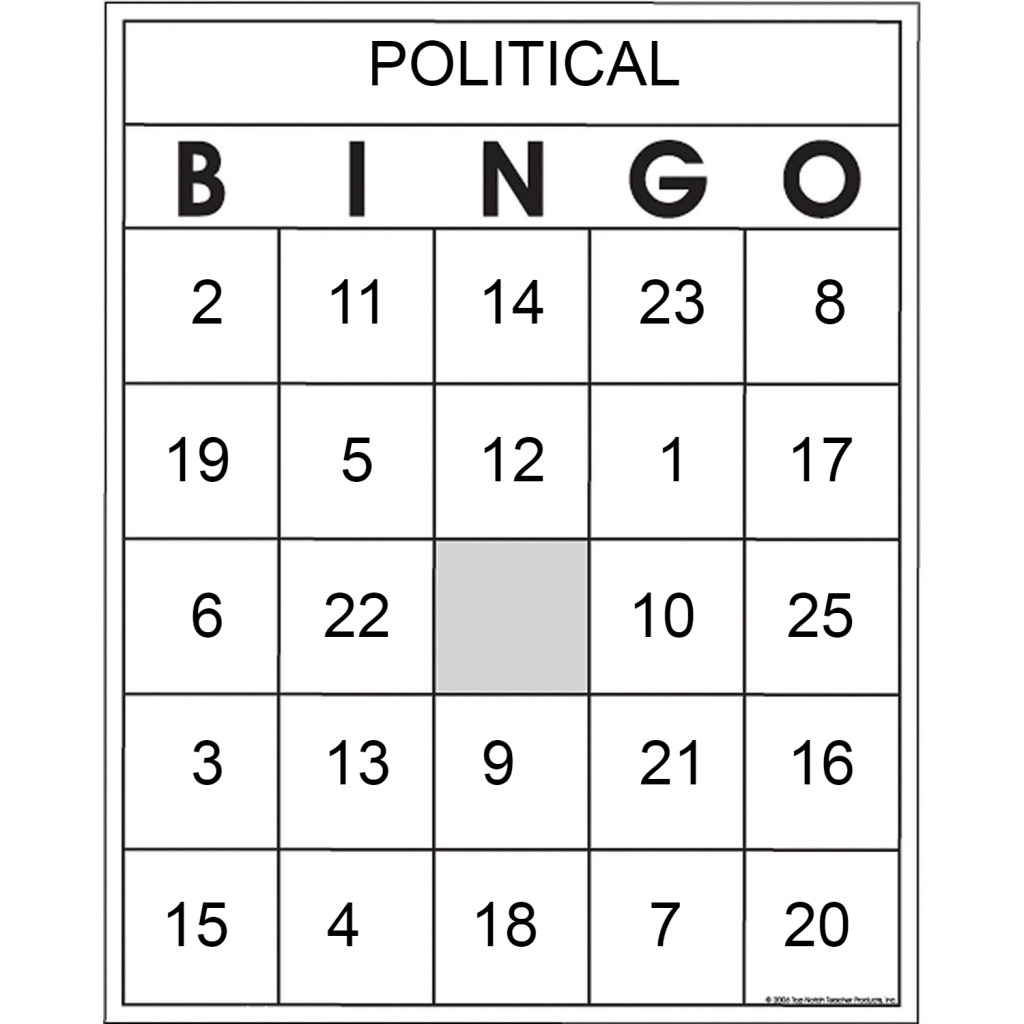
I am so confident of this that I have created a game of political jargon bingo. Download and print the Bingo card accompanying this post. Since it is a jpeg picture file you may need to paste it onto a Word or Google document. Also keep the list of 23 political jargon terms. Then keep an eye on the news – print, broadcast, or social media. Every time a jargon term on the list is mentioned, mark the Bingo card. I used numbers because some of the terms are too long to fit on a Bingo card.

When you hear something like “Taking gloves off,” mark the square with #2 because that’s the number corresponding to the term “Taking the gloves off.” Once you get a straight or diagonal line (the center square on the Bingo card is a free space; you’re welcome) you win.

The first three people to fill out their Bingo cards – the first three who do it and tell me about it, I should say – win a signed copy of my book, A Few Words About Words.

Here’s the Bingo card.

And here is the list of jargon.

Political Bingo. How many of these terms have you heard?

1. Gearing up for

2. Taking the gloves off

3. Stump speech

4. Battleground state

5. Bellwether state

6. Coffers

7. Dark money

8. Inside the beltway

9. PAC

10. War chest

11. Wedge issue

12. Flip flopper

13. Lame duck

14. Malarkey

15. Fake news

16. RINO

17. PUMA

18. Pivot

19. Dog whistle

20. Throw their support behind …

21. Balanced ticket

22. Astroturfing

23. Plank

24. Party apparatus

Have fun. And let’s write carefully out there, people.

Joe Diorio is a writer from Fort Myers, Florida. He is the author of “A Few Words About Words” (Beaufort Books, 2021) and the forthcoming “Murders at Trask: Crisis communications and the art of making nothing happen” (Beaufort, 2024)

A curious mark

By Joe Diorio

Let’s talk about semicolons.

Or, as anyone who has struggled with the usage of that curious punctuation mark may say, let’s not.

But like Elizabeth Warren speaking on the floor of the U.S. Senate a few years ago, I shall nevertheless persist.

Personally, I like using semicolons. I suspect my favor of them comes from the same aspect of my personality that prompts me to shave with an old-fashioned straight edge razor and to occasionally wear a bow tie – but not while I’m shaving. There, I said it for you. I do all of that because, well, I can, and I know a lot of people cannot.

But back to semicolons. In my book, A Few Words About Words. A common-sense look at writing and grammar, I write “I even ghostwrote a book for IBM called The Customer-Centered Enterprise; don’t look for it. It’s out of print.” Then five paragraphs later I add, “Who among you caught the fact that I unnecessarily used a semicolon a few paragraphs earlier? Gotcha, didn’t I?”

Well, here’s the rule on semicolon use from The Chicago Manual of Style (15th edition, so it might have changed. I’m too cheap to buy a new edition.) “The semicolon, stronger than a comma but weaker than a period, can assume either role, though its function is usually closer to that of a period. Its most common use is between two independent clauses not joined by a conjunction.”

Yeah, that’s about as helpful as knowing I can properly knot a bow tie.

Writer Kajornwan Chueng (@Siennafrst) writes on X, “The semicolon, like all other symbols, comes with its own psychological effects on the reader’s emotions IMO. Most ppl read fiction to escape, and I always feel a [semicolon,] or a [colon] bring them back to class subconsciously It isn’t pleasant to stumble across when you’re taking a break.” Good down-to-earth reasoning there, for sure.

If you are interested in a deep dive into this curious punction mark, I recommend Semicolon. The Past, Present, and Future of a Misunderstood Mark by Cecelia Watson, who concludes her fun, 183-page book by explaining why the semicolon persists despite some pushback against ever using it. “It’s impossible to confront assumptions we can’t even see,” she concludes.

Punctuation, like language itself, is always evolving. Most punctuation came about as a way to help readers pace themselves, adding emphasis where it is or isn’t needed.

Speaking of punctuation and language evolving, author Amor Towles, in his wonderful book, The Lincoln Highway, does not use a single quote mark in his 592-page book. Instead, he introduces quotes by indenting and placing a dash before the start of the quote. He allows the character dialogue to speak for itself without needing additional clarifications or modifications, forcing the conversation to carry its weight on its own. And, surprisingly, it works.

Now excuse me while I go straighten my bow tie.

Quick hits

It is never too late to correct something. In 2008, right outside of Wrigley Field, the Chicago Cubs baseball team unveiled a statue of Ernie Banks, the Hall of Fame shortstop who hit 512 home runs in his 19-year career. At the base of the statue were the words, “Let’s play two,” an homage to a favorite quote Banks was known to frequently utter. Unfortunately, the inscription was at first missing an apostrophe. The Cubs sheepishly called the sculptor back to correct this error, proving that something can be cast in stone and can STILL be corrected.

We know WHAT happened. ABC News on January 6 was reporting the story of the door plug that fell off an Alaska Airlines Boeing 737 jet while the aircraft was 16,000 feet above ground and climbing. The reporter quoted a Federal Aviation Administration official as saying they were “trying to figure out what happened.” Begging the FAA’s pardon, but we know what happened; a door flew off while the jet was in the air. (See? I just used a semicolon.) What the FAA was probably about to do was figure out WHY it happened. Yes, I’m nitpicking. Sue me.

Exasperation moment. Good advice from @proofreadjulia on X: “Fashion journalists, please cease and desist from ‘teaming’ one piece of clothing with another. While we’re at it, if you ever see me referring to a book as ‘a read’ you’ll know that my account has been taken over by someone else.” Noted.

Let’s write carefully out there people.

Joe Diorio is the author of A Few Words About Words. A common-sense look at writing and grammar (Beaufort Books, 2021) and the forthcoming Murders at Trask: Crisis communications and the art of making nothing happen, also from Beaufort Books.